Europe Trip Currencies: Euro, Pound and Swiss Franc Explained
A Europe trip can mean euros, pounds and Swiss francs in one week. See which countries use which, how to budget across all three, and worked examples to copy.
On a multi-country Europe trip you will often use three currencies: the euro across the eurozone, the pound sterling in the United Kingdom and the Swiss franc in Switzerland. Pick one home currency for your budget, add up costs in each currency in a single calculation, and pay in the local currency rather than accepting conversion at the card terminal.
- The euro is used across much of the European Union, but the UK uses the pound and Switzerland uses the Swiss franc.
- Plan your whole trip in one home currency and convert each country's costs into it.
- Learn a simple mental shortcut for each currency at the current rate before you go.
- When a card machine offers to charge you in your home currency, paying in the local currency is usually better value.
- Rates in any app are reference rates; your bank or card may apply a different rate and fees.
A classic multi-country Europe trip can take you from London to Paris to Zurich in a week, and that means three currencies: the pound, the euro and the Swiss franc. Each has a different value, prices feel different in each country, and it is easy to lose track of what you have spent. This guide explains which countries use which currency, how to plan a budget that covers all three, and gives worked examples you can reuse for your own route.
Which currencies will you need on a Europe trip?
For most western European routes you will need up to three: the euro (EUR) in eurozone countries such as France, Germany, Italy, Spain, the Netherlands and Austria; the pound sterling (GBP) in the United Kingdom; and the Swiss franc (CHF) in Switzerland and Liechtenstein.
The euro covers a lot of ground, but not all of Europe. Several countries, including Norway, Denmark, Sweden, Poland, Czechia and Hungary, keep their own currencies. If your route goes beyond the euro, pound and franc, check each country before you leave.
| Currency | Code | Where you will use it |
|---|---|---|
| Euro | EUR | Eurozone countries such as France, Germany, Italy, Spain, Portugal, the Netherlands, Belgium, Austria and Ireland |
| Pound sterling | GBP | England, Scotland, Wales and Northern Ireland |
| Swiss franc | CHF | Switzerland and Liechtenstein |
Tip: Banks in Scotland and Northern Ireland issue their own pound notes. They are pounds sterling, but some shops elsewhere in the UK may be unfamiliar with them, so spend them before you cross the border if you can.
How do you budget a trip across three currencies?
Pick one home currency, list every cost in the currency it is priced in, and convert everything to your home currency when you add it up. Keep the original amounts so you can recheck them later against your card statement.
Here is an example for a traveller who earns in US dollars. The rates are illustrative only, so check current rates before you plan:
- 1 EUR = 1.10 USD
- 1 GBP = 1.30 USD
- 1 CHF = 1.15 USD
Accommodation for the whole trip
Three nights in London at 160 GBP, four nights in Paris at 140 EUR and two nights in Zurich at 220 CHF. You can write that as one sum, with multiplication done before addition:
That breaks down as 480 GBP (624.00 USD), 560 EUR (616.00 USD) and 440 CHF (506.00 USD). Notice that two nights in Zurich cost nearly as much as four in Paris. Seeing the costs side by side in one currency makes trade-offs like that obvious.
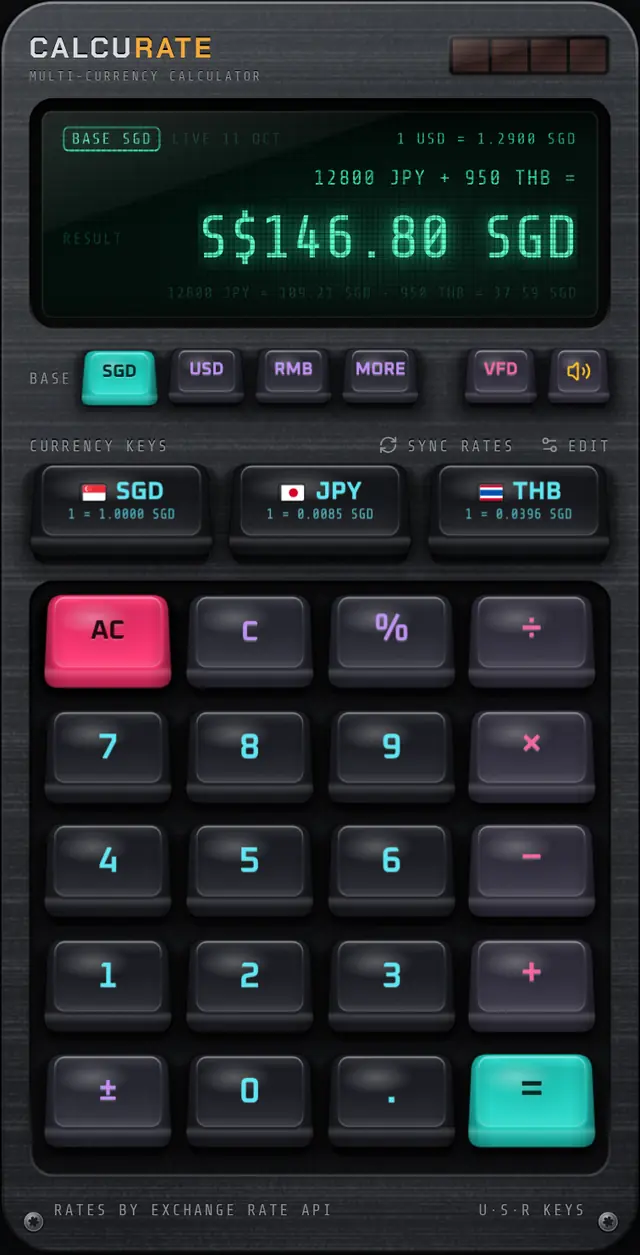
In Calcurate you would set USD as the base currency, use EDIT to put EUR, GBP and CHF on the three quick currency keys, and type the line above. It respects operator precedence, and the breakdown line shows each conversion. The multi-currency maths page explains the keys.
A daily spending allowance
Say you allow 85 EUR a day in France, 60 GBP a day in London and 90 CHF a day in Switzerland for food, transport and sights. How do the days compare in dollars?
That is one day in each country, so 93.50 USD in France, 78.00 USD in London and 103.50 USD in Switzerland. Multiply by the number of days in each and add the accommodation total for a full trip budget. For a step-by-step method, see how to plan a trip budget in multiple currencies.
What are quick mental shortcuts for euros, pounds and francs?
Turn each rate into a simple percentage to add or subtract. With the example rates above, the shortcuts for US dollars are:
- Euros: add 10 percent. A 22 EUR lunch is about 24 USD.
- Pounds: add 30 percent. An 18 GBP lunch is about 23 USD.
- Swiss francs: add 15 percent. A 24 CHF lunch is about 28 USD.
Work out your own shortcuts from the live rates in your home currency before you leave, and write them in your phone notes. Our guide to mental maths for currency conversion shows how to build them.
Should you pay in local currency or your home currency?
Pay in the local currency. When a card terminal or cash machine offers to charge you in your home currency, that is dynamic currency conversion, and the rate is set by the merchant or machine operator rather than your card provider. It is often less favourable. Our guide to dynamic currency conversion explains how to spot and decline it.
In Switzerland, some shops, stations and restaurants may accept euros. If they do, they choose the exchange rate and usually give change in francs. Paying in francs, or by card charged in francs, is generally the cleaner option.
Card fees and cash withdrawal charges depend on your bank and card, and they change. Check your own provider's terms before you travel rather than relying on general advice.
How do you split shared costs in different currencies?
Convert the shared cost to your home currency and divide. A Swiss train ticket for two at 138 CHF, at the example rate of 1 CHF = 1.15 USD:
If you are travelling with someone who thinks in euros, Calcurate lets you change the base currency while the answer is on screen and recalculates it instantly, so you can both see your share in your own currency. Euro, pound and franc are all available as base currencies. For trickier cases, see how to split bills in multiple currencies.
What about service charges and tips?
Customs vary by country and by venue. In some places service is included in the bill; in others a small tip is appreciated. Check the bill first, then add a percentage only if it is not already included.
A calculator with a desk-style percent key does this in one step. A 64 EUR dinner plus 10 percent, at the example rate of 1 EUR = 1.10 USD:
That is 70.40 EUR with the extra included. For more on percentages abroad, see our guide to tax, tips and discounts in other currencies.
What if you lose signal crossing a border?
Use a tool that keeps working offline. Mobile data can drop on trains through mountains and tunnels, and roaming rules can change when you leave the EU for the UK or Switzerland, so check your plan before you go.
Calcurate keeps working with no signal, but only reuses the rates it downloaded for up to an hour. After that, if it cannot reach a rate source, it switches to rates bundled with the app, which go out of date, and the display says OFFLINE, so treat those answers as rough estimates. When you are back online, SYNC RATES fetches fresh ones, and the display shows where the rates came from. More on the live exchange rates page and in our offline currency converter guide.
A simple checklist before you go
- List every country on your route and the currency each uses.
- Choose one home currency for your budget.
- Price accommodation and fixed costs in their own currencies, then total them in one calculation.
- Set a daily allowance per country and convert it to your home currency.
- Write down a mental shortcut for each currency at the current rate.
- Check your card's foreign transaction terms and plan to pay in local currency.
Euros, pounds and francs stop being confusing once every cost ends up in the same currency. This guide is general travel information, not financial advice.
FAQ
Questions people also ask
Does Switzerland use the euro?
No. Switzerland uses the Swiss franc (CHF). Some businesses may accept euros, but they set their own rate and usually give change in francs, so paying in francs or by card in francs is generally simpler.
Does the UK use the euro?
No. The United Kingdom uses the pound sterling (GBP). That includes England, Scotland, Wales and Northern Ireland.
Which European countries do not use the euro?
Several European countries keep their own currency, including the United Kingdom, Switzerland, Norway, Denmark, Sweden, Poland, Czechia and Hungary. Check each country on your route before you go.
How do I budget a trip that uses euros, pounds and francs?
Choose one home currency, list each cost in the currency it is priced in, then convert and add them in one calculation. A currency calculator that accepts mixed currencies in one sum does this in a single step.