How to Calculate Tax and Tip Abroad (Plus Sale Discounts)
Learn to calculate tax and tip abroad: VAT and GST inclusive prices, sales tax added at the till, service charges, stacked discounts, with worked examples.
To calculate tax and tip abroad, first find out whether the shelf price already includes tax (common with VAT and GST) or whether tax is added at the till (as with US sales tax). Add a percentage by multiplying by 1 plus the rate, remove an included tax by dividing by 1 plus the rate, and work out any tip on the amount you choose, then convert the final total into your home currency.
- In many countries with VAT or GST, displayed consumer prices already include tax; in the US and Canada, tax is usually added at the till.
- To add a percentage, multiply by 1 plus the rate. To remove an included tax, divide by 1 plus the rate, do not subtract the percentage.
- Restaurant service charges and taxes often stack (as in Singapore), with tax charged on the price after the service charge.
- Two discounts in a row do not add up: 30% off then 10% off is 37% off, not 40%.
- Tax rates and tipping customs change and vary by place, so check the current rules for your destination.
Percentages follow you around on a trip. There is tax that may or may not be in the price, a service charge on the restaurant bill, a tip you are not sure about, and a sale sign promising 30% off with an extra 10% at the till. Each one is simple on its own, but together, in an unfamiliar currency, they are easy to get wrong. This guide shows how each works, with worked examples you can reuse. All rates below are examples; tax rates and tipping customs change, so check the current ones for your destination.
How do you calculate tax and tip abroad?
Start by finding out whether the price you see already includes tax. Then add any tax that is not included, add a service charge or tip if one applies, and finally convert the total into your home currency.
The two formulas you need cover almost every case:
- Adding a percentage: price × (1 + rate). Adding 10% to 80 is 80 × 1.10 = 88.
- Removing an included percentage: price ÷ (1 + rate). A 110 price that includes 10% tax was 100 before tax.
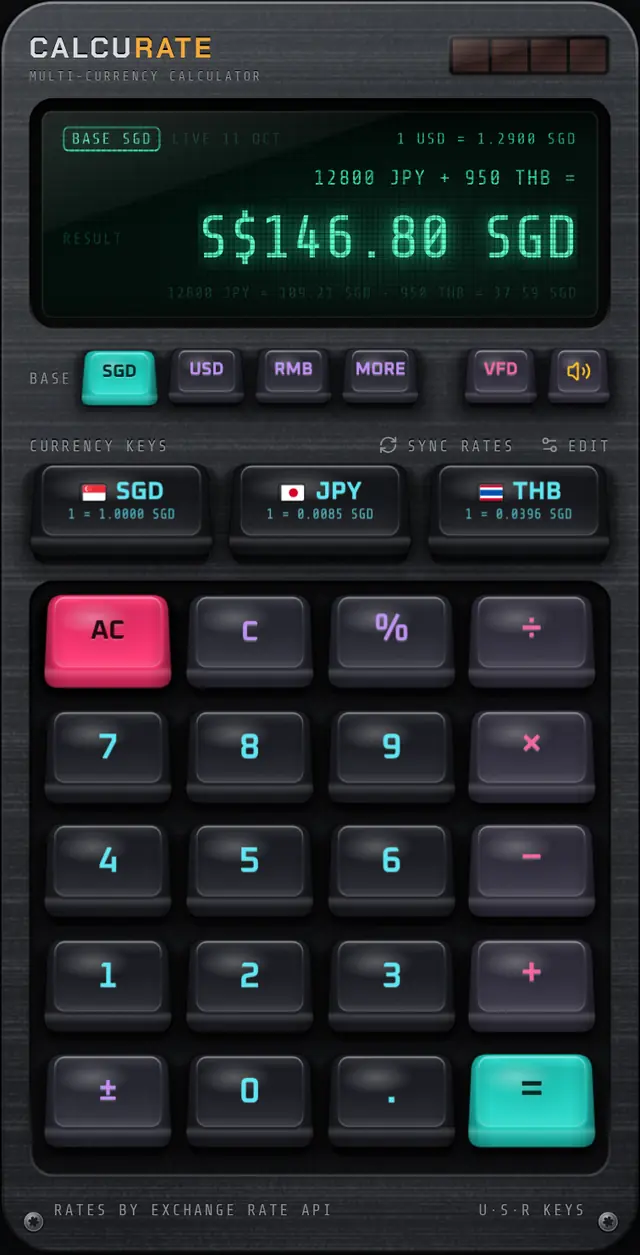
A desk calculator makes the first one even simpler. On calculators with desk-style percent, 200 + 10% gives 220 and 200 − 15% gives 170. Calcurate's percent key works this way, and 80 × 25% gives 20, which is handy for working out a tip on its own.
Is tax included in the price?
It depends on the country. Broadly, there are two systems you will meet as a traveller.
| System | What you see on the shelf | Where you commonly meet it |
|---|---|---|
| Tax-inclusive (VAT or GST) | The price you pay, with tax already included | The UK and EU countries, Australia, Singapore and many others |
| Tax added at the till | A pre-tax price; tax is added when you pay | The United States and Canada |
In the US, sales tax rates vary by state, county and city, so the same item can cost a different amount a few miles away. Check the local rate where you are shopping. In Japan, prices must be shown including consumption tax, though you may also see the pre-tax figure printed alongside it, sometimes larger.
There are exceptions everywhere. Restaurants, hotels and business-to-business price lists sometimes show prices before tax. When in doubt, look for wording like "incl. VAT", "plus tax" or "++".
How do you remove VAT from a price?
Divide the price by 1 plus the VAT rate. Do not subtract the percentage, because the tax was calculated on the smaller, pre-tax amount.
This matters if you are claiming a tourist tax refund or comparing prices with a country where tax is added later. Refund schemes, minimum spends and fees vary by country and by shop, so check the rules before you rely on getting tax back.
How do service charges and taxes stack on a restaurant bill?
They usually apply one after the other, with the tax calculated on the price after the service charge. That means you cannot just add the two rates together and apply them to the menu price.
In Singapore, for example, "++" after a price means a service charge (often 10%) and GST will both be added. Using an illustrative tax rate of 8% to keep the maths clear (not the current GST rate; check the official rate before you go):
Adding 18% straight to 80 would give 94.40, which is close but not what you will be charged. On a desk-style calculator you can do this in two steps: 80 + 10%, press =, then press +, type 8% and press = again. In Calcurate, pressing an operator after = carries the answer forward into the next calculation, so the second step picks up 88 automatically.
Tip: If a bill already shows a service charge, you usually do not need to tip on top. Read the bill before adding more.
How much should you tip, and on what amount?
Tipping customs vary a lot. In the United States, tipping in restaurants is generally expected, and tips often make up a large part of servers' pay. In many other places, a service charge is added instead, or tipping is not customary at all and can even cause confusion. Look up local norms before you go rather than relying on habit from home.
Where you do tip, people commonly tip on the pre-tax amount, though tipping on the total is also common. Here is a US-style example with a pre-tax bill of 64.00 USD, an example sales tax of 8%, and an 18% tip on the pre-tax amount:
If you are splitting the bill with friends, divide the final total, including tax and tip, not the menu price. Our guide to splitting bills in multiple currencies covers groups paying from different home currencies.
How do you calculate stacked discounts?
Apply each discount to the price left after the one before. Two discounts in a row are always worth less than their sum.
The total saving is 74 out of 200, which is 37%, not 40%. The same logic works for a member discount followed by a coupon. If tax is added at the till, it is usually charged on the discounted price, but check the receipt.
To compare a sale price abroad with the price at home, take the final price after discounts and tax, then convert it. Our guide to comparing prices across countries walks through that in detail.
How do you convert the final total into your home currency?
Do the percentages in the local currency first, then convert the final amount once. Converting each step separately adds rounding and makes mistakes more likely.
Using the US bill above and an example rate of 1 USD = 1.30 SGD:
In Calcurate, tag the bill with its currency (type 64, then tap a USD key) before you add the percentages. Then switch the base currency to your own and the answer on screen is recalculated in that currency instantly. Plain numbers with no currency tag are not converted when you switch. The conversion uses mid-market reference rates, so your card statement may differ slightly once your bank's rate and fees are applied. The multi-currency maths page explains tagging amounts and changing the base currency.
When the card terminal offers to charge you in your home currency instead of the local one, think twice. That conversion uses a rate the merchant's provider sets. Our explainer on dynamic currency conversion shows how to compare.
Quick reference
- Add tax, service charge or tip: price × (1 + rate), or
price + rate%on a desk-style calculator. - Remove included tax: price ÷ (1 + rate).
- Stacked charges or discounts: apply them one at a time, in order.
- Tip on its own: price × rate%, for example
64 × 18%. - Convert last: do the local maths first, then convert the final total once.
For rough checks without a calculator, the tricks in currency conversion mental math work for percentages too. If you are planning ahead, build these costs into your multi-currency trip budget so tax and tips do not come as a surprise.
FAQ
Questions people also ask
How do I work out the price before VAT?
Divide the VAT-inclusive price by 1 plus the VAT rate. At an example rate of 20%, a 120 price was 100 before VAT, because 120 divided by 1.2 is 100. Subtracting 20% from 120 gives 96, which is wrong.
Should I tip on the amount before or after tax?
Customs vary, and many people tip on the pre-tax amount, while others simply tip on the total. Either is common where tipping is expected; check local norms for your destination.
What does ++ mean on a menu?
In some places, notably Singapore, ++ means a service charge and a goods and services tax will be added to the listed price. The tax is usually calculated on the price after the service charge.
Do I need to tip if there is a service charge?
Often not. A service charge generally takes the place of a tip, though who receives it varies, so check your bill before adding more, especially in countries where tipping is not customary.