What Is the Mid-Market Rate? (And Why You Rarely Get It)
The mid-market rate is the midpoint between buy and sell prices for a currency. Learn how it works, why banks add a spread, and how to compare quotes.
The mid-market rate is the midpoint between the price buyers are bidding for a currency and the price sellers are asking for it on the wholesale market. It is the fairest single number for what a currency is worth right now, but banks, cards and exchange counters usually charge you a rate a little worse than it, and that gap is part of what you pay.
- The mid-market rate is the halfway point between the wholesale buy (bid) and sell (ask) prices.
- Most consumers are quoted a rate with a spread built in, so the rate you get is usually worse than mid-market.
- Comparing any quote against the mid-market rate shows you the hidden cost of a conversion.
- Mid-market rates move constantly; published reference rates are snapshots taken at a set time.
- Calculators and converters that show mid-market rates are a benchmark, not a promise of what your bank will pay.
Every time you change money, someone quotes you a rate. The mid-market rate is the yardstick you can measure that quote against. Once you know what it is and where to find it, you can estimate how much a bank, card or exchange counter is charging you, even when they say the conversion is "free".
What is the mid-market rate?
The mid-market rate is the midpoint between the bid price and the ask price for a currency pair on the wholesale market. The bid is the highest price buyers are currently willing to pay. The ask (or offer) is the lowest price sellers are willing to accept. The mid-market rate sits exactly halfway between them.
Banks and large institutions trade currencies with each other in huge volumes, so the gap between bid and ask for major pairs is very small. That is why the midpoint is a good estimate of what a currency is really worth at a given moment.
In that example (illustrative numbers, not a live quote), the mid-market rate is 1 USD = 1.3000 SGD. You also see it called the interbank rate, the spot rate or the real exchange rate. These terms overlap, though "interbank" technically refers to rates banks quote each other rather than the midpoint itself.
Why do you rarely get the mid-market rate?
You rarely get it because the business converting your money keeps a slice of every transaction. It buys your currency for a bit less than mid-market and sells you foreign currency for a bit more. That difference is the spread, and it is often the biggest cost of changing money.
The spread is easy to miss because it does not show up as a separate line on a receipt. A counter can advertise "0% commission" and still earn money from a rate several percent away from mid-market. Some providers charge both a spread and a visible fee.
How wide the spread is depends on who you use and where:
- Airport and hotel exchange counters tend to have wide spreads, because customers have few alternatives.
- Banks vary a lot. Some card schemes and banks use rates close to mid-market; others add a markup or a foreign transaction fee.
- Less traded currencies usually come with wider spreads than major pairs like USD and EUR.
- Weekends can bring wider spreads at some providers, since wholesale markets are mostly closed and they protect themselves against price moves.
Card policies and fees change, so check your own card's terms instead of relying on general rules.
How do you calculate the hidden cost of an exchange rate?
Convert the same amount at both rates and compare. The gap is what the conversion really cost you.
Say you want to change 1,000 USD into SGD. At an example mid-market rate of 1 USD = 1.3000 SGD, you would expect 1,300 SGD. An exchange counter offers you 1 USD = 1.2600 SGD.
You lose 40 SGD, about 3% of the value, without any fee being mentioned. Run the same comparison with every option you have, and the cheapest one becomes obvious.
Tip: When a card terminal or ATM abroad asks whether you want to pay in your home currency, the rate it offers is set by the merchant or ATM operator (or their provider), not your bank. Compare it with the mid-market rate before accepting. Our guide to dynamic currency conversion explains why paying in the local currency is often the better choice.
Where does the mid-market rate come from?
There is no single official mid-market rate. Wholesale currency trading happens around the clock across many banks and trading venues, and prices change second by second. Data providers collect these prices and publish their own midpoint figures.
Some institutions also publish reference rates, which are snapshots taken at a fixed time. The European Central Bank, for example, publishes euro reference rates for a set of currencies on working days. These are widely used for accounting and contracts, and they are a reasonable benchmark for everyday conversions too. If you want to know how the underlying prices are formed in the first place, read how exchange rates are set.
Because sources sample at different times, two apps can show slightly different "mid-market" rates for the same pair. Small differences like that are normal. Large ones usually mean one source is out of date.
Mid-market rate vs buy rate vs sell rate
Exchange counters often show two numbers per currency. The table below uses illustrative rates for SGD per USD to show how they relate.
| Rate | Example (SGD per 1 USD) | What it means for you |
|---|---|---|
| We buy | 1.2600 | What you get when you sell USD to the counter |
| Mid-market | 1.3000 | The benchmark midpoint, which you rarely get |
| We sell | 1.3400 | What you pay when you buy USD from the counter |
The counter always wins on both sides. The closer its buy and sell numbers are to each other, the smaller its spread, and the better the deal for you.
How should you use the mid-market rate when travelling?
Use it as your reference point for every decision: which card to use, whether to change cash before you go, and whether a price in a shop is good value.
- Know the benchmark. Check the mid-market rate before you change money or pay, so you know what a fair number looks like.
- Compare the offer. Work out the percentage gap as shown above. A gap of a fraction of a percent is very different from one of several percent.
- Add visible fees. A good rate with a high flat fee can still be expensive for small amounts.
- Budget with a margin. If you plan a trip at mid-market rates, assume your real costs will be a little higher once spreads and fees are included.
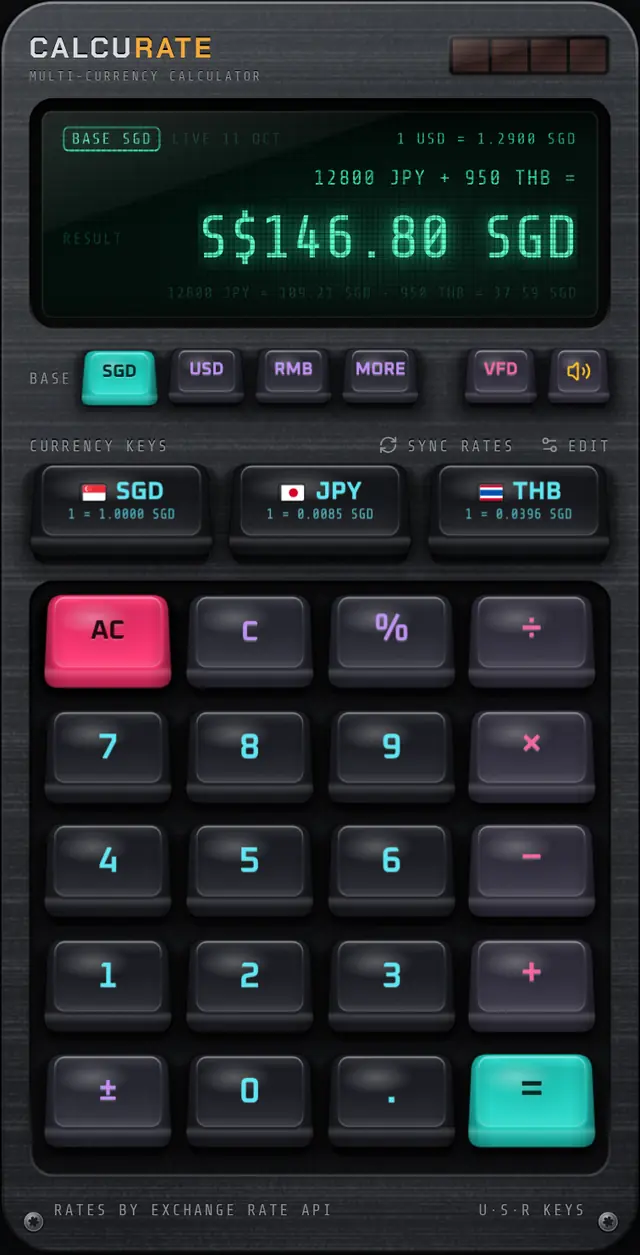
For quick sums while you are out, a calculator that shows mid-market rates is handy. Calcurate uses mid-market reference rates and shows the source and date on the display (for example LIVE 10 OCT or ECB 09 OCT), so you can see how fresh your benchmark is. You can read more about where those rates come from on the live exchange rates page.
Is the mid-market rate what a calculator app will charge you?
No. A calculator does not move money, so it does not charge anything. Calcurate is a calculator that converts at mid-market reference rates, which makes it useful for estimating and comparing, but your bank or card will apply its own rate when you actually pay. The gap between the two is the cost you are trying to spot.
That is also why mixing currencies in one sum is useful. If you are adding up 120 USD + 85 SGD + 300 RMB to see a trip total, a mid-market figure gives you a clean baseline. The multi-currency maths page shows how that works, and the currencies page lists the 15 currencies supported.
Quick summary
The mid-market rate is the midpoint between wholesale buy and sell prices. It is the most neutral measure of a currency's value, and consumers rarely get it because providers build a spread into their rates. Look it up before you convert, compare it with what you are offered, and treat the difference as a cost. If you want to sanity-check rates in your head, our guide to currency conversion mental math shows simple shortcuts.
FAQ
Questions people also ask
What is the mid-market rate in simple terms?
It is the midpoint between what buyers are willing to pay for a currency and what sellers are asking for it on the wholesale market. If the bid is 1.2990 and the ask is 1.3010, the mid-market rate is 1.3000.
Why can I not get the mid-market rate at my bank?
Banks and exchange counters make money by buying currency below the mid-market rate and selling it above. The difference, called the spread, is added on top of any separate fees they charge.
Is the mid-market rate the same as the rate shown on currency websites?
Many websites and apps show a mid-market or reference rate, but each source takes its figure from a different provider at a different moment, so numbers can differ slightly. Treat any of them as a benchmark rather than the exact rate you will be charged.
How do I work out how much a bad exchange rate costs me?
Convert the same amount at the mid-market rate and at the rate you were offered, then subtract. The difference, divided by the mid-market amount, gives you the hidden markup as a percentage.