How to Split a Bill in Different Currencies (Step by Step)
To split a bill in different currencies, convert every expense into one settle-up currency, divide, then net off what each person paid. Full worked example.
Agree on one settle-up currency and one set of exchange rates, convert every shared expense into that currency, add them up and divide by the number of people. Then compare each person's fair share with what they actually paid, and the differences tell you who owes whom.
- Agree on the settle-up currency and the rate source before anyone does any maths.
- Convert every shared expense into the settle-up currency, then total and divide.
- Each person's balance is what they paid minus their fair share. Positive means they are owed money.
- Settle with as few transfers as possible by matching the biggest debtor with the biggest creditor.
- Apply service charges and tips in the original currency before converting.
Group trips get messy at the end. One friend booked the hotel in Singapore dollars, another kept paying for dinners in Thai baht, and someone put the boat tour on a US dollar card. Now everyone wants to know who owes what. The fix is a short, repeatable method that works for any mix of currencies, and you only need a calculator to do it.
How do you split a bill in different currencies?
Convert every shared expense into one agreed currency, add them up, divide by the number of people, then subtract each person's share from what they paid. The result tells you who owes money and who is owed it.
- Agree on a settle-up currency and a source for exchange rates.
- List every shared expense with who paid and the currency it was paid in.
- Convert each expense into the settle-up currency.
- Total and divide to get each person's fair share.
- Work out balances: what each person paid minus their fair share.
- Settle with as few transfers as possible.
Step 1: agree on the currency and the rate first
Settle these two questions before anyone touches a calculator, because changing them later changes everyone's numbers.
- Currency. Pick the one you will actually transfer money in afterwards. For a group from Singapore, that is SGD.
- Rate. The mid-market rate on an agreed day is neutral, since no bank markup favours anyone. The other option is for each payer to use the amount on their card statement, which includes whatever their bank charged. Either works. Mixing the two does not.
A worked example: four friends, three currencies
Alice, Ben, Chloe and Dan spend a long weekend in Bangkok and settle in SGD. Here is what each person paid for the group. The example rates are 1 SGD = 25.00 THB and 1 USD = 1.30 SGD (illustrative only).
| Who paid | What | Amount | In SGD |
|---|---|---|---|
| Alice | Hotel | 600 SGD | 600.00 |
| Ben | Dinners | 7,500 THB | 300.00 |
| Chloe | Boat tour | 150 USD | 195.00 |
| Dan | Taxis | 1,250 THB | 50.00 |
| Total | 1,145.00 | ||
Baht convert by dividing (7,500 ÷ 25 = 300), and dollars convert by multiplying (150 × 1.30 = 195). Then divide the total by four:
How do you work out who owes whom?
Subtract each person's fair share from what they paid. A positive balance means the group owes them money; a negative balance means they owe the group.
| Person | Paid | Fair share | Balance |
|---|---|---|---|
| Alice | 600.00 | 286.25 | +313.75 |
| Ben | 300.00 | 286.25 | +13.75 |
| Chloe | 195.00 | 286.25 | −91.25 |
| Dan | 50.00 | 286.25 | −236.25 |
The balances always add up to zero. Here, +313.75 + 13.75 = 327.50, and −91.25 − 236.25 = −327.50. If yours do not cancel out, an expense was missed or converted the wrong way.
How do you settle up with the fewest payments?
Match the person who owes the most with the person owed the most, and repeat. In the example:
- Dan pays Alice 236.25 SGD. Dan is now square, and Alice is still owed 77.50.
- Chloe pays Alice 77.50 SGD. Alice is now square.
- Chloe pays Ben 13.75 SGD. Everyone is square.
Three transfers instead of the dozen you would get if everyone paid everyone back for each item.
Tip: Keep a running list on your phone during the trip: who paid, what for, the amount and the currency. Rebuilding it from memory on the last night is where most disagreements start.
How do you split one restaurant bill in a foreign currency?
Add any service charge or tip in the local currency, divide, then convert each share if people want to know it in their own money. Say dinner for three comes to 2,400 THB with a 10% service charge:
At the example rate of 1 SGD = 25.00 THB, that is 35.20 SGD each. Doing the percentage first matters because the restaurant calculates it in baht. For more on local tipping and tax conventions, see percentages abroad.
What if people should not pay equal shares?
Split each expense only among the people who used it. If Dan skipped the boat tour, divide the 195.00 SGD between the other three (65.00 each) and give Dan a share of zero for that line. Then add up each person's shares across all expenses to get their fair share for the trip, and carry on from the balances step as before.
For uneven room costs (a couple sharing one room while two friends take singles), split by room first, then by person within the room.
Doing the whole split in one calculation
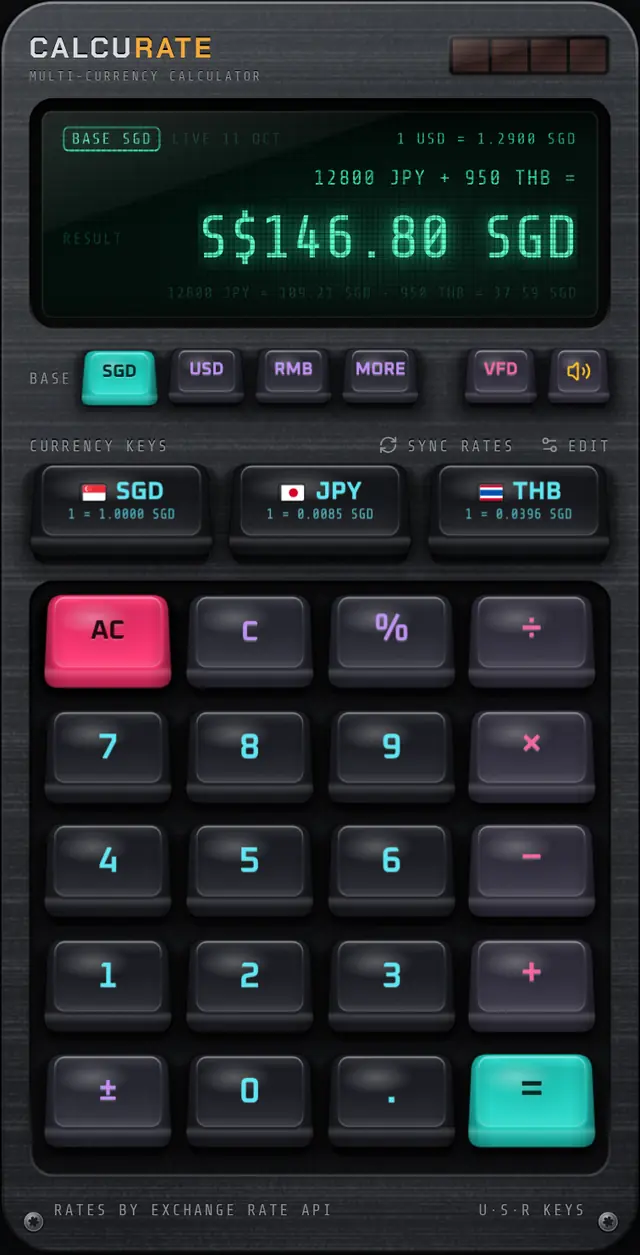
The slow part of a multi-currency split is converting every line. A calculator that handles currencies directly removes that step. In Calcurate, with SGD as the base currency, you type the expenses as one sum:
(Same example rates as above.) Then press ÷, type 4 and press =. After =, an operator carries the answer forward in the base currency, so you get 286.25 SGD without retyping anything. The breakdown line under the result shows each conversion, which is useful when a friend asks how you got their number.
Calcurate has up to three quick currency keys above the keypad, so set them to the currencies you are actually using on this trip. You can change which ones appear with the EDIT key. The multi-currency maths page has more detail, and the full list is on the currencies page.
Calcurate is a calculator only. It does not track expenses or move money, so you still settle up using whatever payment method your group prefers.
Common mistakes when splitting bills across currencies
- Using different rates for different expenses without agreeing on it. Choose one source for the whole trip.
- Dividing before adding the service charge. Add percentages in the original currency first.
- Flipping a rate. If 7,500 THB comes out as 187,500 SGD, you multiplied when you should have divided.
- Forgetting non-shared costs. Personal shopping should stay off the shared list.
- Rounding too early. Round each person's final transfer, not each line.
If you want to plan ahead so the split is easy, start with a shared travel budget in multiple currencies. And for the basic technique behind all of this, see how to add different currencies together.
FAQ
Questions people also ask
What currency should a group settle up in?
Usually the currency most of the group earns in, because that is how money will actually change hands afterwards. If everyone is from different countries, pick the one you will use for transfers and agree on it up front.
Which exchange rate is fairest for splitting costs?
The mid-market rate on an agreed date is the most neutral choice, because nobody gains from a bank markup. Alternatively, each payer can use the exact amount their card statement shows, but agree on one approach for the whole trip.
How do you split a restaurant bill with service charge in another currency?
Add the service charge or tip to the bill in the local currency first, then divide by the number of people, then convert each share if needed. The merchant calculates the percentage in their own currency, so this matches what was paid.
How do you minimise the number of payments when settling up?
Work out each person's balance, then have the person who owes the most pay the person who is owed the most, and repeat with what is left. This usually needs fewer transfers than everyone paying everyone.