Currency Conversion Mental Math: 7 Shortcuts That Work
Convert prices in your head with simple currency conversion mental math: round the rate, drop zeros, use easy fractions and a reference ladder. Worked examples.
The easiest currency conversion mental math is to round the exchange rate to a friendly number, turn it into a simple fraction or percentage, and drop zeros before you multiply. For example, at an example rate of 1 USD = 150 JPY, a 4,800 yen price becomes 48 × 2/3, which is 32 US dollars. Learn a few anchor amounts before you travel and check bigger purchases with a calculator.
- Round the rate to a number that is easy to multiply or divide by, and remember which way you rounded.
- Drop zeros first: dividing by 150 is the same as dropping two zeros and multiplying by 2/3.
- Turn rates near 1 into percentages, such as adding 10% or 30%.
- Memorise a short reference ladder (100, 500, 1,000, 5,000 in local currency) before you travel.
- Mental maths is for quick decisions; check large purchases with an exact calculation.
You are standing at a market stall, or reading a menu, and you want to know one thing: is this expensive? Pulling out your phone for every price gets tiring. With a few simple tricks, you can convert most prices in your head in a couple of seconds, accurately enough to make a good decision. All the rates below are examples chosen to make the maths clear, so swap in the current rate for your trip.
What is the simplest way to do currency conversion in your head?
Round the rate to a friendly number, then use it as a fraction or a percentage. You do not need the exact rate to decide whether a 4,800 yen lunch is reasonable. You need a number that is close and easy to work with.
The steps are always the same:
- Look up the current rate before you go, ideally the mid-market rate.
- Round it to something easy, like 1.3, 25, 150 or 1,350.
- Find a shortcut for that number (a fraction, a percentage or dropping zeros).
- Remember whether you rounded up or down, so you know which way your estimate leans.
Shortcut 1: Drop the zeros first
For currencies with large numbers, start by dropping zeros. This turns big, awkward figures into small ones you can handle.
Take an example rate of 1 USD = 150 JPY. Dividing by 150 is the same as dropping two zeros (dividing by 100) and then dividing by 1.5, which is the same as multiplying by 2/3.
The exact answer at that example rate is 4,800 ÷ 150 = 32, so the shortcut is spot on here. Our Japan yen shopping guide has more examples for yen prices.
Shortcut 2: Turn awkward divisors into easy multipliers
Dividing by 25 is hard in your head; multiplying by 4 is easy. Many rates have a friendly partner like this.
At an example rate of 1 SGD = 25 THB, to turn baht into Singapore dollars you multiply by 4 and drop two zeros.
Useful pairs to remember:
- Divide by 25: multiply by 4, then divide by 100.
- Divide by 50: multiply by 2, then divide by 100.
- Divide by 20: halve, then divide by 10.
- Divide by 5: double, then divide by 10.
If the real rate is a little off a friendly number, use the friendly number anyway and accept a small error. The Thailand baht money guide goes deeper on baht prices.
Shortcut 3: Use percentages for rates near 1
When a rate is close to 1, think of it as "add or subtract a percentage". This works well for pairs like EUR and USD, or USD and SGD.
At an example rate of 1 EUR = 1.10 USD, converting euros to dollars means adding 10%.
At an example rate of 1 USD = 1.30 SGD, add 30%. An easy way to find 30% is to find 10% and triple it.
Shortcut 4: Use "per thousand" for very small units
For currencies where a coffee costs thousands, learn what 1,000 units is worth and count in thousands. The Korean won is a good example.
At an example rate of 1 USD = 1,350 KRW, 1,000 won is worth about 0.74 USD. Round that to three quarters of a dollar.
The exact figure at that example rate is about 33.33 USD, so the shortcut leans slightly high, which is the safe direction. For more on counting big numbers in won, see our Korean won guide.
Shortcut 5: Build a reference ladder before you go
A reference ladder is a short list of common local amounts and what they are worth to you. Memorise it, or keep it in your notes, and you can convert most prices by comparison instead of calculation.
| Local price (THB) | About (SGD), at example rate 1 SGD = 25 THB |
|---|---|
| 100 | 4 |
| 500 | 20 |
| 1,000 | 40 |
| 5,000 | 200 |
With that table in your head, 750 baht is obviously "between 20 and 40, about 30". A home screen widget does the same job without memorising. Calcurate's currency widgets can show a pair's rate both ways and, on the Medium or wide size, three round amounts converted, right on your home screen.
Shortcut 6: Round in the safe direction
Round the rate so that prices look slightly more expensive in your home currency. Your estimates will then lean high, and you will be pleasantly surprised rather than caught out.
For example, if the real rate is 1 USD = 1.35 SGD and you are converting USD prices into SGD, rounding to 1.3 makes things look about 4% cheaper than they are. Rounding to 1.4 makes them look slightly more expensive. When budgeting, the second is safer. Card spreads and fees can push your real cost up too, so a little caution in your rounding helps cover them.
Shortcut 7: Know when to stop doing it in your head
Mental maths is perfect for a menu or a street stall. It is not the right tool for a hotel bill, a flight or anything where a few percent is real money. It also gets harder when you are adding prices in several currencies at once, such as a trip total with costs in dollars, baht and yuan.
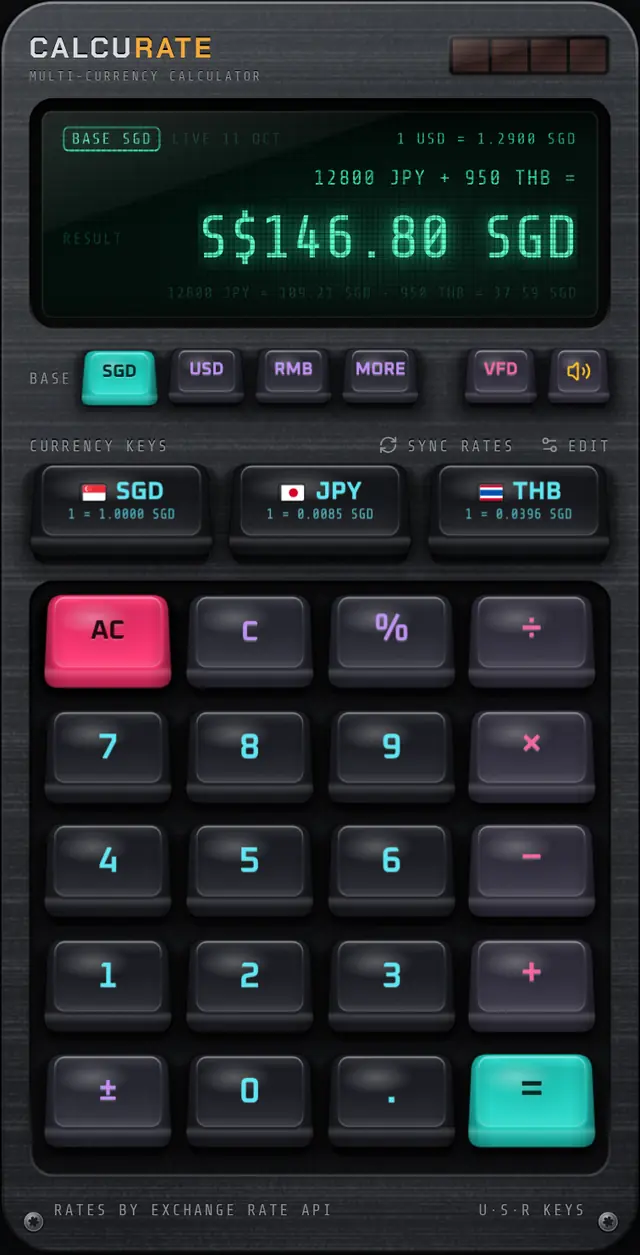
For those cases, use an exact calculation. In Calcurate you can type a mixed sum like 120 USD + 85 SGD + 300 RMB and get one total in the currency you choose, with a breakdown line showing each conversion. See multi-currency maths for how it works, or our guide on adding prices in different currencies for the method in general.
Tip: Practise on the flight or train. Pick five prices from a menu or website for your destination, convert them in your head, then check them. After a few rounds the shortcuts become automatic.
Quick reference: which shortcut for which rate?
- Rate near 1 (EUR, USD, SGD, GBP pairs): add or subtract a percentage.
- Rate around 20 to 50 (for example THB per SGD): turn the divisor into a multiplier, then drop zeros.
- Rate around 100 to 200 (for example JPY per USD): drop two zeros, then adjust with a simple fraction.
- Rate in the thousands (for example KRW per USD): count in thousands and learn what 1,000 is worth.
Whatever the currency, the idea is the same: make the number friendly, know which way you rounded, and check the big ones properly.
FAQ
Questions people also ask
How do I convert currency in my head quickly?
Round the exchange rate to a friendly number, drop any zeros, then multiply or divide using a simple fraction. For example, if 1 SGD is about 25 THB, divide baht by 25 by multiplying by 4 and dropping two zeros.
Should I round the exchange rate up or down?
Round in the direction that makes prices look more expensive to you, so your estimate errs on the safe side. Then you are unlikely to overspend because of rounding.
How accurate is mental currency conversion?
With a sensibly rounded rate you are usually within a few percent of the exact figure, which is enough to judge whether something is good value. Card spreads and fees vary and can add to your real cost, so allow a margin.
What is the easiest way to convert yen to dollars in my head?
Drop the last two zeros from the yen price, then adjust for the rate. At an example rate of 1 USD = 150 JPY, multiply the result by 2/3, so 3,000 yen is about 20 US dollars.