How to Plan a Travel Budget in Multiple Currencies
Plan a multi-currency travel budget by listing costs in the currency you will pay, converting to your home currency and adding a buffer. Full worked example.
List every trip cost in the currency you will actually be charged in, convert them all into your home currency at one set of reference rates, and add them up. Add a buffer for card fees and rate changes, then turn the daily spending part back into local currency so you have a simple allowance to follow on the ground.
- Write each cost in the currency it will be charged in, not a converted guess.
- Convert everything to your home currency using one set of rates, and note the date.
- Add a buffer (many travellers use around 10%) to cover fees and rate movement.
- Turn daily spending into a local-currency allowance so you can check it without converting.
- Recheck the plan with fresh rates before you go and again during the trip.
A trip that crosses two or three currencies is harder to budget than one that does not. Prices arrive in yen, won and dollars, some are paid months ahead and some at the counter, and the exchange rate keeps moving underneath you. A good multi-currency travel budget handles all of that with a simple structure. This guide shows the method and works through a full example.
How do you make a travel budget in multiple currencies?
List every cost in the currency you will be charged in, convert each one to your home currency at one set of rates, add them up and add a buffer. Then convert your daily spending back into local currency so you have an allowance you can follow without doing maths at every meal.
- Choose your home currency as the budget's master currency.
- List costs by category in their charging currency.
- Convert and total at one set of reference rates.
- Add a buffer for fees and rate movement.
- Set daily allowances in each local currency.
- Recheck with fresh rates before and during the trip.
Why list costs in the currency you will pay?
Because that is the only number that stays fixed. A hotel priced at 15,000 JPY a night will cost 15,000 JPY whatever the rate does. If you write down a converted figure instead, your budget silently goes out of date as rates move. Keep the original amount and currency, and convert from it whenever you need a fresh total.
It also helps to mark each cost as paid or to pay. Once a cost has been charged and settled, the rate no longer matters for it. Only unpaid costs carry exchange rate risk.
A worked example: 10 days in Tokyo and Seoul
Here is a budget for a traveller from Singapore spending six nights in Tokyo and four in Seoul. The home currency is SGD. Example rates are 1 SGD = 110 JPY, 1 SGD = 1,000 KRW and 1 USD = 1.30 SGD (illustrative only, not current rates).
| Cost | Charged in | Amount | In SGD |
|---|---|---|---|
| Flights | SGD | 900 | 900.00 |
| Tokyo hotel, 6 nights × 15,000 | JPY | 90,000 | 818.18 |
| Seoul hotel, 4 nights × 120,000 | KRW | 480,000 | 480.00 |
| Tokyo daily spending, 6 days × 8,800 | JPY | 52,800 | 480.00 |
| Seoul daily spending, 4 days × 70,000 | KRW | 280,000 | 280.00 |
| Travel data plan | USD | 25 | 32.50 |
| Subtotal | 2,990.68 | ||
Yen and won convert by dividing (90,000 ÷ 110 = 818.18), dollars by multiplying (25 × 1.30 = 32.50). Large won amounts are easy to misread, so count the zeros twice. Our guide to big Korean won numbers has shortcuts for that.
How much buffer should you add?
Add a percentage on top of the subtotal to cover things that are hard to predict: card fees, ATM charges, rate movement on unpaid costs and the small extras every trip has. Many travellers use about 10%. If your card charges a foreign transaction fee, or you plan to withdraw cash often, you may want more. Fees vary widely, so look at your own card terms rather than guessing.
That 3,289.75 SGD is the number to plan your savings around.
How do you set a daily allowance in local currency?
Use the local-currency figure you budgeted per day and carry it in your head. In the example, that is 8,800 JPY a day in Tokyo and 70,000 KRW a day in Seoul. When you check what you have spent, compare it with those numbers directly. You only need to convert back to SGD when you want to see the trip total.
Thinking in local currency also makes price decisions faster. If lunch is 1,500 JPY and your daily allowance is 8,800 JPY, you know at a glance that it fits. For more on reading prices in Japan, see our yen shopping guide.
Tip: Separate fixed costs (hotels, flights, passes) from flexible ones (food, shopping, taxis). The fixed part rarely changes once booked, so the daily allowance is where you actually manage the budget.
What happens to your budget when exchange rates move?
Only unpaid costs change. Suppose the yen strengthens so that 1 SGD buys 105 JPY instead of 110 (an illustrative move). The unpaid Tokyo daily spending of 52,800 JPY would then cost about 502.86 SGD instead of 480.00, roughly 23 SGD more. Your flights, already paid in SGD, do not change at all.
This is the job your buffer does. Recalculate the budget with fresh rates a week or two before you leave, and you will see whether the buffer is still enough.
Building the budget with a multi-currency calculator
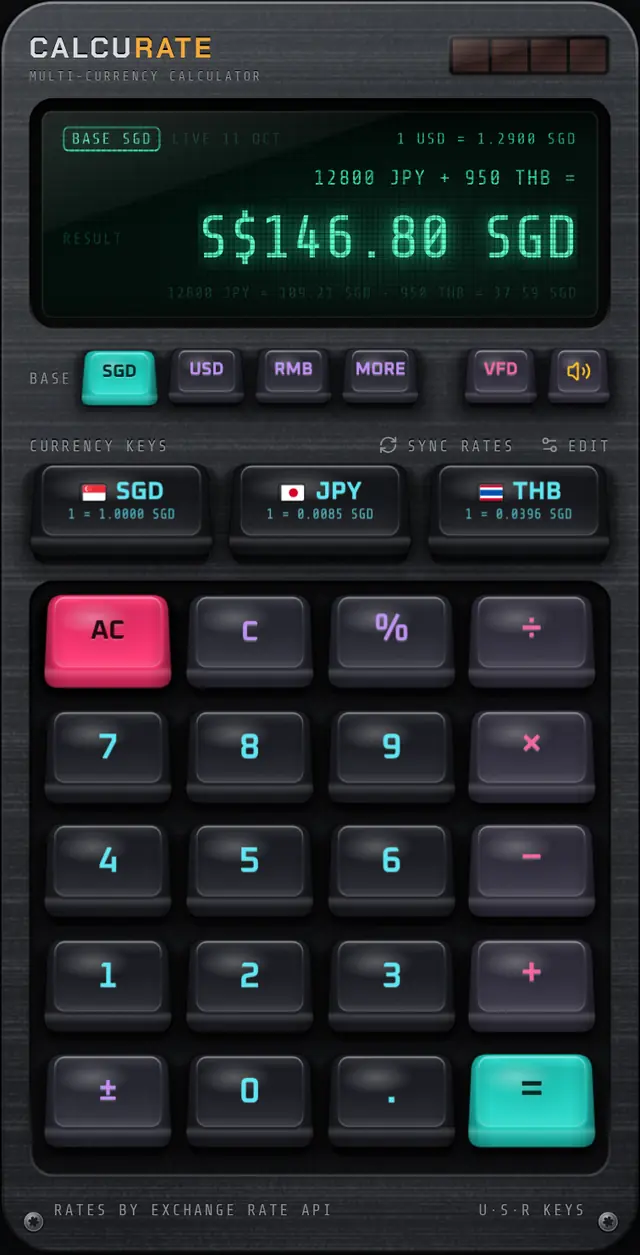
Converting each line separately is the tedious part. A calculator that accepts mixed currencies lets you total the whole budget in one go. In Calcurate, with SGD as the base currency, you can type:
(Using the example rates above, with JPY, KRW and USD on the three quick currency keys. A plain number with no currency tag counts as the base currency, so the 900 is read as SGD.) Then press +, type 10, tap % and press = to add the buffer. The breakdown line shows each conversion so you can copy the converted figures into your plan.
Two more features help with planning:
- Switch the base currency while the answer is on screen, for example to JPY, and the total is recalculated in yen straight away. That is a quick way to see what your budget looks like in local money.
- Home screen widgets show the exchange rate for a currency pair without opening the app. Set one to SGD and JPY for the Tokyo leg. See home screen widgets for how they work on iPhone and Android.
Rates in Calcurate are mid-market reference rates with their source and date shown on the display, so your budget is based on a neutral figure. Your card's actual rate may differ slightly. More on that on the live exchange rates page.
Keeping the budget on track during the trip
- Check spending each evening against the daily allowance in local currency.
- Roll over savings. If you spent 6,800 JPY instead of 8,800, you have 2,000 JPY extra tomorrow.
- Pay in local currency when a card terminal offers to charge you in your home currency. That offer often comes with a worse rate. Our guide to dynamic currency conversion explains why.
- Keep shared costs separate if you are travelling with others, then follow the method in splitting bills in different currencies at the end.
A travel budget in multiple currencies does not need special software. It needs costs kept in their own currency, one set of rates, an honest buffer and a daily number you can remember.
FAQ
Questions people also ask
Should I budget in my home currency or the local currency?
Both. Plan and total the trip in your home currency, because that is the money you have. Then convert the daily spending part into each local currency so you can follow it easily while travelling.
How much buffer should a travel budget include for exchange rates?
There is no fixed rule, but many travellers add around 10% on top of the converted total. It covers rate movement, card fees and the small costs nobody plans for. Check your own card's fees to decide.
Do exchange rate changes matter for costs I have already paid?
No. Once a cost is paid and settled in your home currency, rate changes no longer affect it. Only unpaid costs, such as pay-at-hotel bookings and daily spending, move with the rate.
How do I budget for a trip that crosses several countries?
Give each country its own section with costs in its own currency, convert each section to your home currency, and add them. Set a separate daily allowance in each local currency.