Thai Baht Travel Money Guide: Cash, Cards and Quick Maths
How to handle Thai baht travel money: cash or card, ATM habits, reading "++" bills, bargaining in baht and converting prices fast. With worked examples.
For Thai baht travel money, carry some cash for markets, street food and taxis, use a card for hotels and larger shops, and always choose to be charged in baht. To convert quickly, divide by 100 and multiply by 3 for a rough US dollar figure (at an example rate of 1 USD = 35 THB, 1,000 baht is about 29 USD).
- Cash in baht is still the easiest way to pay at markets, street food stalls and many small businesses.
- Foreign cards are widely accepted in hotels, malls and chain restaurants, but check your card fees before you travel.
- Thai ATMs commonly charge foreign cards a withdrawal fee, so fewer, larger withdrawals usually cost less in fees.
- A "++" price means service charge and tax are added on top, so the bill will be higher than the menu price.
- When a card machine or ATM offers to convert to your home currency, choose baht instead.
Thailand is easy to travel in, and money is one of the easier parts once you know a few local habits. You will use cash more than you might at home, menus sometimes show prices before service and tax, and markets expect a bit of bargaining. This guide covers how to carry and spend Thai baht, plus quick conversions with clearly labelled example rates.
Should you use cash or card in Thailand?
Use both: cash for small, everyday spending and a card for bigger, sit-down purchases. Street food, night markets, small cafes, tuk-tuks and many local shops prefer or only take cash. Hotels, shopping malls, chain restaurants and larger stores generally accept foreign cards, and contactless is common in cities.
A sensible split for most trips:
- Cash in baht for food stalls, markets, taxis, temple entry, tips and small shops.
- Card for hotels, malls, sit-down restaurants, tours booked at a desk and anything large.
- A backup card kept separately, in case one is lost or blocked.
Before you fly, check your cards for foreign transaction fees. Policies vary a lot between cards and banks, and the difference adds up over a two-week trip.
How do you convert baht prices quickly?
Divide the baht price by 100 and multiply by 3 to get a rough US dollar figure. At an example rate of 1 USD = 35 THB, the exact factor is about 2.86 per 100 baht, so the shortcut comes out slightly high. That is the safe direction for budgeting.
| Price in baht | Shortcut (÷100 ×3) | Exact at example rate 1 USD = 35 THB |
|---|---|---|
| 60 THB | about 1.80 USD | 1.71 USD |
| 350 THB | about 10.50 USD | 10.00 USD |
| 1,000 THB | about 30 USD | 28.57 USD |
| 2,500 THB | about 75 USD | 71.43 USD |
If you think in Singapore dollars, at an example rate of 1 SGD = 25 THB, divide by 25, which is the same as dividing by 100 and multiplying by 4. Work out your own factor from the current rate before you go. Our guide to mental maths for currency conversion has more shortcuts.
How should you use ATMs in Thailand?
Withdraw fewer, larger amounts. Thai ATMs commonly charge foreign cards a fixed fee for each withdrawal, and your own bank may add a fee too. Because the ATM fee is per withdrawal, taking out more at once means paying it less often.
- Use ATMs attached to bank branches or inside malls where you can.
- Read the fee shown on screen before you confirm. Cancel if it is not what you expected.
- If the ATM offers to convert the withdrawal into your home currency, decline and choose baht.
- Only carry what you need for a day or two. Leave the rest in your hotel safe.
Exchange booths are another option for cash you bring with you. Rates vary from booth to booth, so compare two or three before you change a large amount. The difference between their rate and the mid-market rate is effectively their fee.
What does "++" mean on a Thai menu or bill?
A "++" after a price means service charge and VAT will be added to it. You will mostly see this at hotel restaurants, bars and upmarket places. Street food and casual restaurants usually show the price you pay.
The percentages are printed on the menu or bill. Using 10% service charge and 7% VAT as example figures, a 1,200 baht dinner works out like this:
Add the two percentages one after the other, not together. The tax is charged on the price after service. For more on percentages on bills, see our guide to tax, tips and discounts abroad.
How do you bargain in baht without losing track?
Convert the asking price and your target price before you start, so you know what the gap is actually worth. At markets, haggling is normal for clothes, souvenirs and crafts. It is not expected at food stalls, supermarkets, malls or anywhere with printed prices.
Say a seller asks 450 baht for a shirt and you would pay 300:
The gap is about 4 USD. Knowing that helps you decide how hard to push, and when to smile and pay. Keep a mix of small notes so you can pay the agreed price without waiting for change.
Tip: Some attractions in Thailand charge visitors a different entry price from residents. Check the price board before queuing so the amount at the ticket window is not a surprise.
How do you track a trip budget in baht and your own currency?
Keep everything in one running total in your home currency. Your flights and hotel may be in US dollars or your own currency, while daily spending is in baht. Adding them on one screen tells you where you stand.
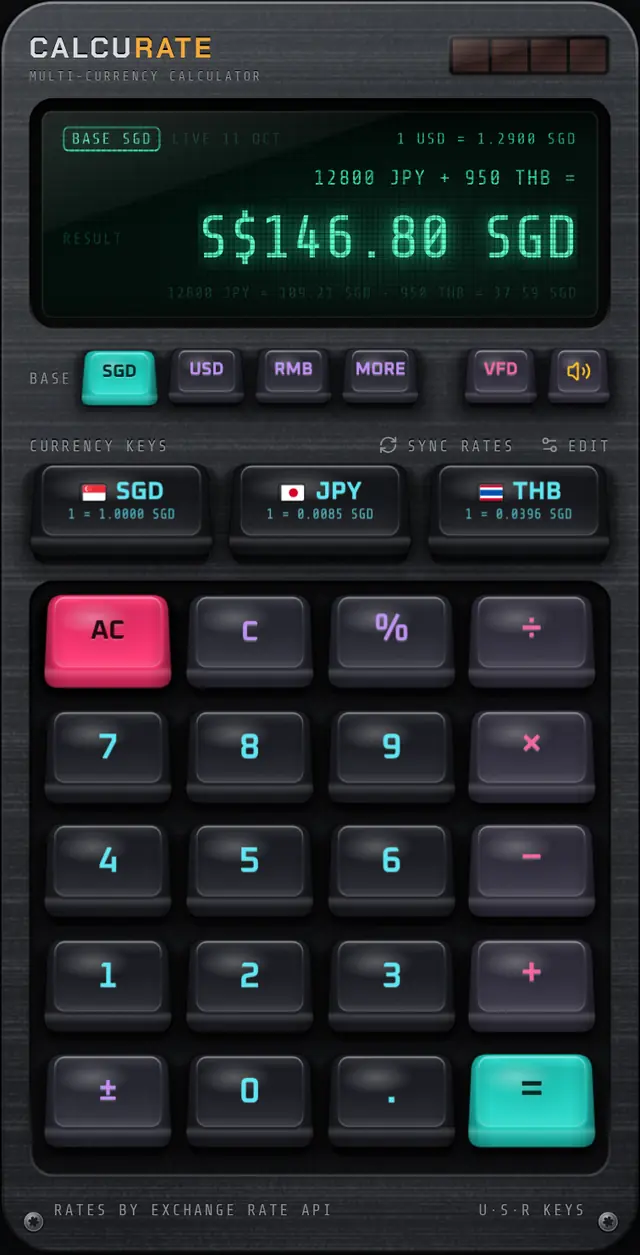
In Calcurate you can put THB on one of the three quick currency keys and set your home currency as the base, if it is one of the base currency options. Type the hotel cost, tap USD, add the baht you have spent, tap THB, and press =. Every amount is converted and added up, with a breakdown line showing each conversion.
The percent key handles "++" bills the same way as above: 1200 THB, + 10%, + 7%. Calcurate uses live mid-market reference rates with their source and date on the display, and if you lose signal on an island the calculator keeps working. It reuses rates cached within the last hour, then switches to rates bundled with the app and shows OFFLINE on the display, so treat those results as rough estimates. See live exchange rates and multi-currency maths for how that works. For planning before you go, our trip budget guide walks through a full multi-currency budget.
Should you pay in baht or your home currency?
Pay in baht. If a card machine, hotel desk or ATM asks whether you want to be charged in your own currency, that is dynamic currency conversion, and the rate is set by the merchant or provider, often less favourably than your card network rate. Our article on dynamic currency conversion explains what to look for on the screen and the receipt.
Thai baht money checklist
- Check your cards for foreign transaction fees and tell your bank you are travelling if it asks you to.
- Work out your conversion shortcut from the current rate.
- Carry baht in small notes for markets, food and taxis.
- Withdraw fewer, larger amounts and read the ATM fee on screen.
- Add "++" charges one at a time to see the real bill.
- Convert asking and target prices before bargaining.
- Always choose baht when a machine offers a currency choice.
With those habits in place, money in Thailand becomes a background task, and you can get back to the food. Browse the full list of supported currencies if you are combining Thailand with other stops.
FAQ
Questions people also ask
Is it better to use cash or card in Thailand?
Use both. Cash in baht works best at markets, street food stalls, small shops and taxis, while cards are widely accepted at hotels, malls and larger restaurants. Check your card terms for foreign transaction fees before you go.
What does "++" mean on a Thai menu?
It means service charge and VAT are added to the listed price. Add the service charge first, then the tax on top, to see what you will actually pay. The exact percentages are shown on the menu or bill.
How do I convert baht to dollars in my head?
Divide the baht price by 100 and multiply by 3. At an example rate of 1 USD = 35 THB this gives a slightly high estimate, which is safer than a low one: 600 baht becomes about 18 USD, against an exact 17.14 USD.
Do ATMs in Thailand charge foreign cards?
Thai ATMs commonly charge a fixed fee per withdrawal on foreign cards, and your own bank may add its own fee. The screen should show the ATM fee before you confirm, so read it and cancel if it is not what you expected.