Singapore Dollar Travel Money: GST, "++" Prices and Paying
Singapore dollar travel money made simple: what "++" means on menus, how GST and service charge add up, cards versus cash, and fast conversions with examples.
In Singapore, most shop prices already include GST, but restaurant prices marked "++" have a service charge and then GST added on top, so a 48 SGD dish can cost about 57.55 SGD. Cards and contactless payments work almost everywhere, though some hawker stalls prefer cash. Choose to pay in Singapore dollars when a terminal offers a choice.
- "++" on a menu means service charge is added first, then GST is charged on the total.
- Adding the two percentages one after another gives a slightly higher bill than adding them together.
- Most retail price tags already include GST; the "++" convention is common at restaurants, bars and hotels.
- Tipping is not generally expected, especially where a service charge is already on the bill.
- Visitors may be able to claim a GST refund on eligible goods taken out of Singapore; check IRAS for current conditions.
Singapore is one of the easiest places in the world to spend money. Cards work almost everywhere and prices are clearly marked. The one thing that catches visitors out is the small "++" next to restaurant prices, which can add a noticeable amount to your bill. This guide explains how GST and service charge work, how to pay, and how to convert Singapore dollars to your own currency, using clearly labelled example rates.
What does "++" mean on Singapore prices?
"++" means two charges are added to the listed price: a service charge, then Goods and Services Tax (GST). You will see it at sit-down restaurants, bars, hotel dining and some cafes. Hawker centres and food courts generally show the price you pay.
The service charge is commonly 10%, and GST has been 9% since the start of 2024. Both are shown on the menu or the bill, so check there, since rates can change and not every venue adds a service charge.
The order matters. The service charge is added first, and GST is then charged on the price including service charge. So a dish listed at 48++ works out like this:
A desk-style calculator lets you chain this in one line, 48 + 10% + 9%, because each percentage is applied to the running total.
Why is "++" not the same as adding 19%?
Because GST is charged on the service charge too. Adding 19% in one step gives 48 + 19% = 57.12 SGD, which is 43 cents short of the real bill. On a single dish that is small. On a group dinner of 600 SGD before charges, the gap grows:
If you are splitting that bill, the 5.40 SGD difference is worth getting right. Our guide on splitting bills in multiple currencies covers sharing costs when friends think in different currencies.
Do shop prices in Singapore include GST?
Yes, retail price tags in shops generally already include GST, so the price on the shelf is what you pay at the till. The "++" convention is mainly a restaurant and hospitality habit. If you are unsure, ask, or look for "nett" on the menu, which means the listed price is final.
Can visitors get GST back on shopping?
Possibly. Singapore runs a Tourist Refund Scheme that allows eligible visitors to claim back GST on qualifying goods they take out of the country, through participating shops. There are conditions, including a minimum spend, and the process happens partly at the shop and partly at the airport or other departure point.
Conditions can change, so check the IRAS (Inland Revenue Authority of Singapore) website before you shop, and ask the store whether it takes part. Keep your receipts and the goods together, as you may be asked to show them.
Tip: When comparing a Singapore shop price with the price at home, compare like with like. The Singapore tag includes GST. If you expect a refund, work out the price without it only after you have confirmed you qualify.
How do you pay in Singapore?
By card or contactless for almost everything. Visa and Mastercard are widely accepted, as are mobile wallets, and you can tap a contactless card or phone on public transport in many cases. Check with your card issuer whether foreign transaction fees apply, since policies vary.
Carry a small amount of cash for hawker stalls and small shops. Many hawkers accept cards or QR payments now, but not all, and some local QR systems are linked to Singapore bank accounts, which visitors usually do not have.
When a card terminal asks whether you want to pay in your home currency or in Singapore dollars, choose Singapore dollars. Letting the terminal convert for you is called dynamic currency conversion, and the rate it uses is often worse than your card network's.
How do you convert Singapore dollars quickly?
Learn one multiplier for your own currency and round generously. Here are some examples:
| Your currency | Example rate | Quick rule | 50 SGD is about |
|---|---|---|---|
| US dollar | 1 USD = 1.30 SGD | take about three quarters | 38.46 USD |
| Euro | 1 EUR = 1.50 SGD | take two thirds | 33.33 EUR |
| British pound | 1 GBP = 1.75 SGD | take a little under six tenths | 28.57 GBP |
These rates are illustrative. Check the current rate before your trip and adjust. Our guide to mental maths for currency conversion has more shortcuts for doing this on the spot.
How do you budget a Singapore trip in two currencies?
Add everything up in one currency, including bookings you paid in another. Flights might be in US dollars, the hotel in Singapore dollars and a side trip in ringgit. Converting each one separately and adding by hand is slow and easy to get wrong.
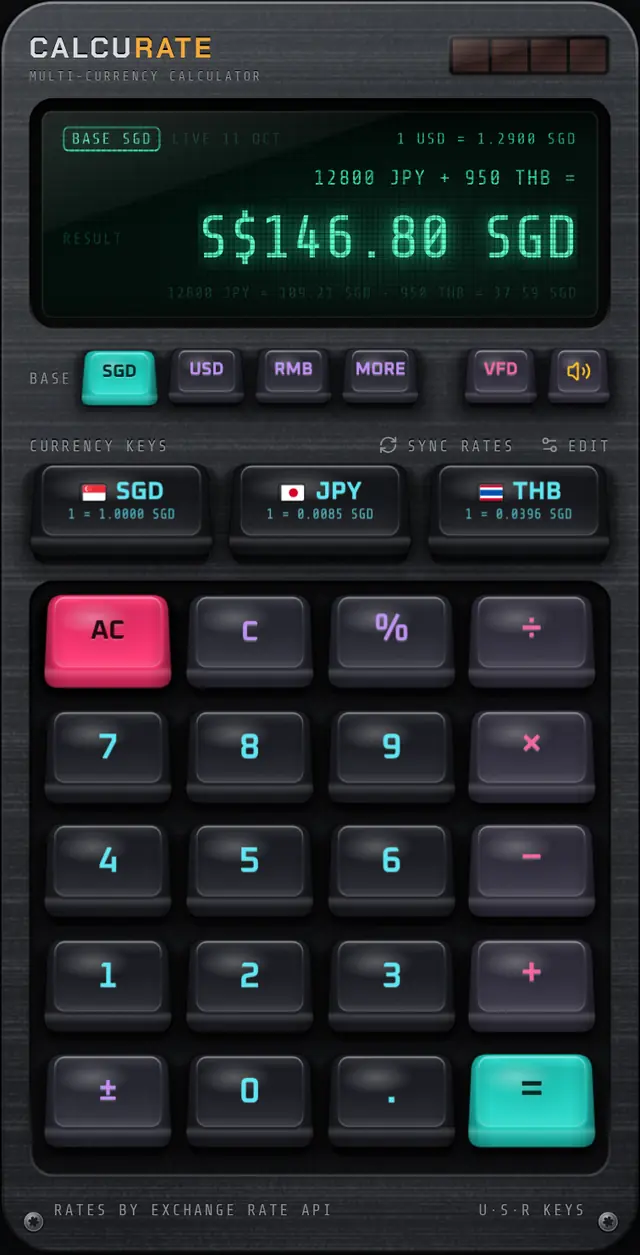
In Calcurate you can do it in one line. Tag each amount with its currency key and press =, and every amount is converted to your base currency and added up, with a breakdown line showing each conversion:
The percent key handles "++" in the same calculation: 48 SGD, + 10%, + 9%. Change the base currency while the answer is on screen and it is recalculated instantly, so you can see the bill in US dollars without retyping. Read more on the multi-currency maths page. Calcurate uses mid-market reference rates with their source and date shown, so treat them as a close guide rather than your card's exact rate.
For a whole trip plan, our guide to budgeting a trip in multiple currencies walks through each step.
Does the "$" sign always mean Singapore dollars?
In Singapore, a plain "$" on a price tag means Singapore dollars. Online, and on booking sites, "$" can mean US, Australian or another dollar, so look for "S$" or "SGD" before you assume. Using ISO codes like SGD and USD when you note down costs avoids mix-ups later.
Singapore travel money checklist
- Check your cards for foreign transaction fees before you fly.
- Expect "++" at sit-down restaurants and add service charge, then GST.
- Look for "nett" when you want the final price on the menu.
- Carry a little cash for hawker stalls.
- Choose Singapore dollars when a terminal offers a currency choice.
- Check IRAS for current Tourist Refund Scheme conditions before a big purchase.
- Write down costs with currency codes, not just "$".
Once "++" stops being a surprise, Singapore is about as straightforward as travel money gets. See the full list of supported currencies if you are combining it with other stops in the region.
FAQ
Questions people also ask
What does "++" mean on a Singapore menu?
It means a service charge and GST will be added to the listed price. The service charge is applied first and GST is then charged on the price including service charge. The percentages are shown on the menu or bill.
Do I need to tip in Singapore?
Tipping is not generally expected in Singapore. Many restaurants already add a service charge to the bill, and hawker centres and food courts do not expect tips.
Can tourists get a GST refund in Singapore?
Singapore has a Tourist Refund Scheme that lets eligible visitors claim back GST on qualifying goods they take out of the country. Minimum spend and other conditions apply, so check the IRAS website and ask the shop before you buy.
Is cash still needed in Singapore?
You can pay by card or contactless almost everywhere, including public transport. Some hawker stalls and small shops still prefer cash, so carrying a small amount of Singapore dollars is sensible.