Yen Conversion for Shopping in Japan: A Practical Guide
Convert yen fast while shopping in Japan: read tax labels, do quick mental maths, add up a basket and compare with prices at home. Worked examples inside.
To convert yen while shopping in Japan, knock two zeros off the price and adjust for your currency (at an example rate of 1 USD = 150 JPY, 10,000 yen is about 67 USD). Check whether the tag says tax included (税込) or tax excluded (税抜), add up your basket before converting, and pay in yen if a card terminal offers a choice.
- Yen has no decimal places, so prices look big; dropping two zeros gives you a quick reference number.
- Tags marked 税込 include consumption tax; tags marked 税抜 do not, so the till price will be higher.
- Add your whole basket in yen first, then convert once, so rounding errors do not pile up.
- Tax-free shopping rules for visitors have been changing, so check the official Japan tourism site before you go.
- If a card machine offers to charge you in your home currency, choosing yen usually avoids a worse conversion rate.
Shopping in Japan is a pleasure until you try to work out what 26,800 yen means in your own money while a queue builds behind you. Yen prices have no decimals, so every number looks large. This guide gives you a fast way to convert in your head, explains the tax labels you will see on price tags, and walks through real shopping maths with clearly labelled example rates.
How do you convert yen prices quickly?
Drop the last two zeros, then adjust for your currency. That turns 3,300 yen into 33, which is your reference number. What you do next depends on where you are from.
- US dollars, at an example rate of 1 USD = 150 JPY: take two thirds of the reference number. 3,300 yen becomes 33, and two thirds of 33 is 22 USD.
- Singapore dollars, at an example rate of 1 SGD = 115 JPY: take a little under nine tenths. 3,300 yen becomes 33, so about 29 SGD.
- Euros, at an example rate of 1 EUR = 165 JPY: take about six tenths. 3,300 yen becomes 33, so about 20 EUR.
Rates move, so before your trip work out your own multiplier from the current rate and write it down. For more tricks like this, see our guide to mental maths for currency conversion.
What do 税込 and 税抜 mean on Japanese price tags?
税込 (zeikomi) means the price includes consumption tax, and 税抜 (zeinuki) means it does not. Most shops in Japan show the tax-included price, which is what you pay. Some tags show both figures, with the tax-excluded number printed larger, so it pays to look for the characters before you convert.
If a tag only shows a tax-excluded price, add the tax before converting. The standard consumption tax rate has been 10% for some years, with a reduced rate for certain food and drink, but check the tag or receipt rather than assuming. On a desk-style calculator the percent key makes this a single step.
Our article on percentages abroad covers tax, discounts and service charges in more detail.
How do you add up a shopping basket in yen?
Add everything in yen first, then convert the total once. Converting each item separately and rounding along the way can leave you a few dollars out by the end of the day.
Say you pick up a jacket, a pair of trainers and some souvenirs:
| Item | Price (tax included) |
|---|---|
| Jacket | 12,800 JPY |
| Trainers | 4,980 JPY |
| Souvenirs | 2,200 JPY |
| Total | 19,980 JPY |
A quick sense check with the two-zeros trick: 19,980 yen is about 200, and two thirds of 200 is about 133. The numbers agree, so you have not slipped a digit.
Is it cheaper to buy in Japan than at home?
Sometimes, and the only way to know is to convert the Japanese price and compare it with the price you would pay at home, including any tax you would pay there. Look up the home price on your phone before you get to the counter.
For example, a camera lens costs 26,800 yen in Tokyo and 189 USD at home:
That looks like a saving of about 10 USD. Before you celebrate, think about what else applies:
- Card fees. Many cards add a foreign transaction fee on purchases abroad. Check your card terms; some charge nothing, some charge a percentage.
- Warranty. Electronics bought abroad may only carry a local warranty.
- Compatibility. Some electronics sold in Japan are set up for the Japanese market (language menus, plugs, region settings).
- Customs at home. Your own country may charge duty or tax on goods you bring back above a set allowance. Check your customs authority before buying big-ticket items.
For comparisons across several currencies at once, see how to compare prices in different currencies.
How does tax-free shopping in Japan work for visitors?
Japan runs a tax-free shopping scheme for eligible visitors at participating shops, which usually display a tax-free sign. You normally need your passport, and there are rules about minimum spend, which goods qualify and whether items must stay sealed until you leave Japan.
These rules have been changing, including how the tax is handled (removed at the till or refunded later). Rather than rely on a figure in a blog post, check the Japan National Tourism Organization website and ask at the shop's tax-free counter. When you compare a tax-free price with a home price, make sure you know which price you will actually pay on the day.
Tip: Keep tax-free purchases and receipts together in your hand luggage. If staff at the airport ask to see them, you will not be digging through a suitcase.
Should you pay in yen or in your own currency?
Pay in yen. When a card terminal or ATM asks whether you want to be charged in your home currency, that is dynamic currency conversion. The conversion is done at a rate the merchant or terminal provider chooses, and it is often worse than the rate your card network would use. Our guide to dynamic currency conversion explains how to spot it.
Cash is still common in Japan, especially at small restaurants, temples and market stalls, though cards and contactless payments are widely accepted in cities. Carry some yen for the places that only take cash.
How do you keep a running total during a shopping day?
Keep a running total in yen and check it against your budget in your own currency. A calculator that handles more than one currency saves you converting back and forth.
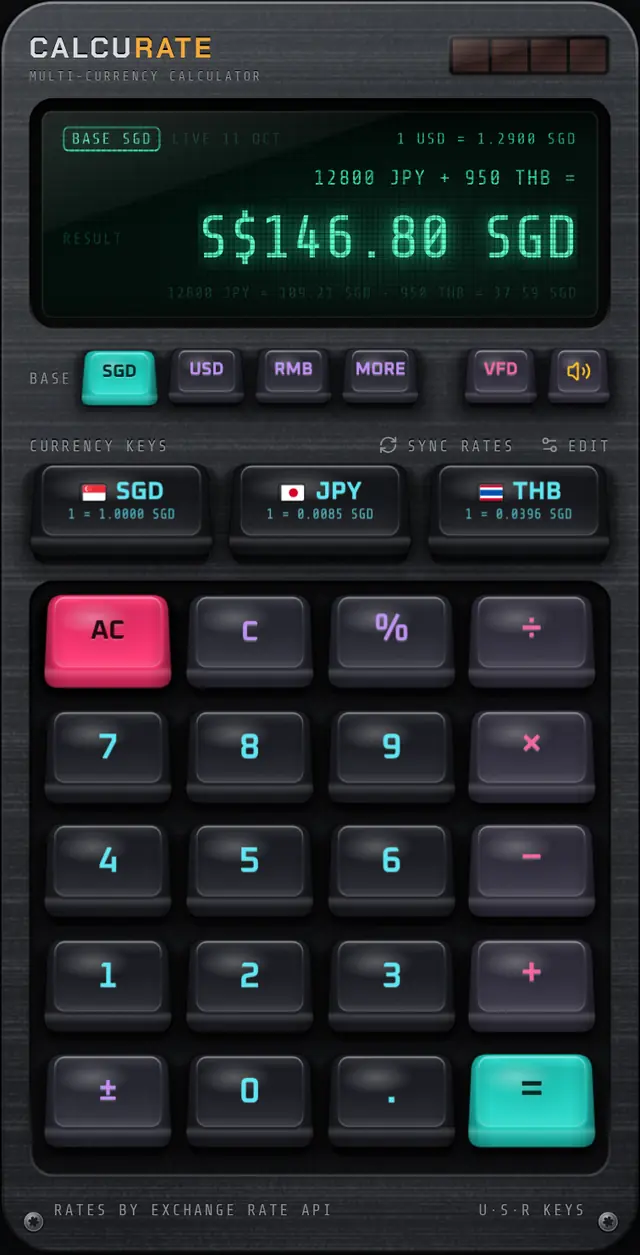
In Calcurate you can set JPY as one of your three quick currency keys and keep your home currency as the base (if it is one of the currencies on the base keys). Type 12800, tap JPY, add 4980 JPY, and press =. The answer appears in your base currency, with a breakdown line showing each conversion. Yen shows no decimals, the way it does on a price tag. You can read more on the multi-currency maths page.
It also helps with mixed budgets. If your hotel was booked in US dollars and you are spending yen on the ground, you can add them in one line:
If you want a rate at a glance without opening anything, a medium or wide home screen widget set to convert from JPY to your currency shows the rate and a few round amounts. See home screen widgets. Rates in Calcurate are mid-market reference rates, shown with their source and date, so treat the answer as a close guide rather than the exact amount your card will charge.
Quick checklist before you shop
- Work out your personal multiplier from the current rate and note it on your phone.
- Look for 税込 (tax included) or 税抜 (tax excluded) on every tag.
- Add the basket in yen, then convert once.
- Look up the home price before buying anything expensive.
- Check the official tax-free rules and carry your passport.
- Pay in yen when a terminal offers a choice.
- Carry some cash for smaller places.
With those habits, a 26,800 yen price tag stops being a puzzle and becomes a quick decision. For more on how rates are sourced, see live exchange rates or browse the full list of supported currencies.
FAQ
Questions people also ask
What is the easiest way to convert yen in your head?
Drop the last two zeros, then adjust for your currency. At an example rate of 1 USD = 150 JPY, 100 yen is about 0.67 USD, so 5,000 yen becomes 50 and then roughly two thirds of that, about 33 USD.
Are prices in Japan shown with tax included?
Most shops show the tax-included price, marked 税込. Some tags show a tax-excluded price as well, marked 税抜, and the amount you pay at the till will be the tax-included one.
Can tourists shop tax-free in Japan?
Japan has a tax-free shopping scheme for eligible visitors, but the rules, minimum spends and the way the exemption or refund is handled have been changing. Check the Japan National Tourism Organization website and the shop itself before you rely on it.
Should I pay in yen or my home currency in Japan?
Paying in yen is usually the better choice. When a terminal converts to your home currency for you, the rate it uses is set by the merchant or terminal provider and is often worse than your card network rate.