Vacuum Fluorescent Display: How VFDs Work and Why They Glow
A vacuum fluorescent display glows when electrons strike phosphor in a vacuum tube. See how VFDs work, why calculators used them, and how they compare to LCD.
A vacuum fluorescent display (VFD) is a small vacuum tube in which a heated filament releases electrons that strike phosphor-coated segments, making them glow, usually blue-green. VFDs were common in calculators, hi-fi equipment, video recorders and car dashboards because they are bright and easy to read. LCDs replaced them in most portable devices because they use far less power.
- A VFD has a filament, a control grid and phosphor-coated anodes inside an evacuated glass envelope.
- Segments glow when electrons hit them, so VFDs emit their own light and need no backlight.
- The classic blue-green colour comes from the phosphor; filters and other phosphors give other colours.
- VFDs were widely used in 1970s calculators and in hi-fi, VCRs, microwaves and car dashboards.
- LCDs took over in battery-powered devices because they need very little power.
If you have ever seen a 1970s desk calculator, an old stereo receiver or the clock on a microwave glow a soft blue-green, you have probably seen a vacuum fluorescent display. VFDs have a look that is hard to fake: sharp, bright characters that seem to float behind dark glass. Here is how they work, where they were used, and how they compare with the LCDs that replaced them.
What is a vacuum fluorescent display?
A vacuum fluorescent display is a flat vacuum tube that lights up shapes, such as digit segments, by firing electrons at phosphor. It belongs to the same family of technology as the old radio valve, but instead of amplifying a signal, it turns electricity into glowing characters.
VFDs were developed in Japan in the 1960s and became widespread in the following decade. Because they emit their own light, they are easy to read in a dim room, and the characters stay visible from steep angles.
How does a VFD work?
Three parts inside a sealed, evacuated glass envelope do the work.
- Filament (cathode). Very thin wires stretched across the front of the display are heated just enough to give off electrons. They are so fine that you can barely see them, though if you look closely at an old VFD you may spot them.
- Grid. A fine metal mesh sits between the filament and the segments. Applying a voltage to the grid lets electrons through or blocks them, which is how the display chooses which digit position is lit.
- Anodes with phosphor. Each segment is an anode coated with phosphor. When a segment is switched on, it attracts electrons, and the phosphor glows where they hit.
Displays with several digits usually light one digit at a time, very quickly, in a process called multiplexing. Your eye blends the flashes into a steady image. This is why a VFD can drive many segments with relatively few connections.
Tip: The faint mesh pattern you can sometimes see over VFD digits is the grid. It is part of the authentic look, and many replicas include it on purpose.
Why do VFDs glow blue-green?
Because the most common phosphor used in VFDs glows in that colour. It is bright, efficient and sits in a part of the spectrum where human eyes are sensitive, which helped VFDs look crisp. To get other colours, manufacturers placed coloured filters over the glass or used different phosphors. That is how you got the blues, ambers and reds on some stereo equipment and car dashboards.
Where were vacuum fluorescent displays used?
Almost anywhere a device needed bright numbers and could plug into the wall or a car battery.
- Calculators. Many desk and pocket calculators of the 1970s used VFDs. Earlier desk calculators often used Nixie tubes, and many pocket calculators of the same period used red LED digits instead.
- Hi-fi equipment. Receivers, amplifiers, tape decks and CD players used VFDs for frequency readouts, track numbers and level meters.
- Video recorders and microwaves. The glowing clock on a VCR or a microwave was very often a VFD.
- Cars. Dashboards, clocks and radios used them, partly because VFDs keep working well in cold weather, when LCDs can become sluggish.
- Shops. Cash registers and customer-facing price displays used them because they can be read easily from across a counter.
Why did LCDs replace VFDs in calculators?
Mainly because of power. A VFD has to keep its filament warm and drive electrons across a vacuum, which takes noticeably more energy. A liquid crystal display does not make light at all. It only twists light passing through it to darken segments, so it uses a tiny amount of power.
That difference changed what calculators could be. With an LCD, a calculator could run for a very long time on small batteries, or on a solar cell, and could be made much thinner. By the 1980s, the grey-green LCD had become the standard look of a pocket calculator.
How do VFD, amber phosphor and LCD compare?
Each has a distinct character. Amber is included here because amber phosphor screens were a well-known look on monochrome computer monitors and terminals, even though those were cathode ray tubes rather than VFDs.
| VFD | Amber phosphor | LCD | |
|---|---|---|---|
| Makes its own light | Yes | Yes | No (needs room light or a backlight) |
| Typical colour | Blue-green | Warm orange-yellow | Dark grey on grey-green |
| Power use | Relatively high | High (CRT monitors) | Very low |
| Readability | Bright, wide viewing angle, good in the dark | Bright and warm, readable in a dim room | Best in good light, can be hard to read at an angle |
| Where you saw it | Calculators, hi-fi, VCRs, cars | Computer terminals and monitors | Pocket calculators, watches, handhelds |
VFDs have a weakness too. With heavy use, the phosphor gradually loses brightness, so a display that showed the same digits for years can look uneven.
Why does the VFD look still appeal?
Because it carries a sense of precision and warmth at the same time. The glow suggests a machine that is switched on and working, and the segment digits are instantly readable. That is why designers keep returning to it for clocks, audio gear and retro-styled apps.
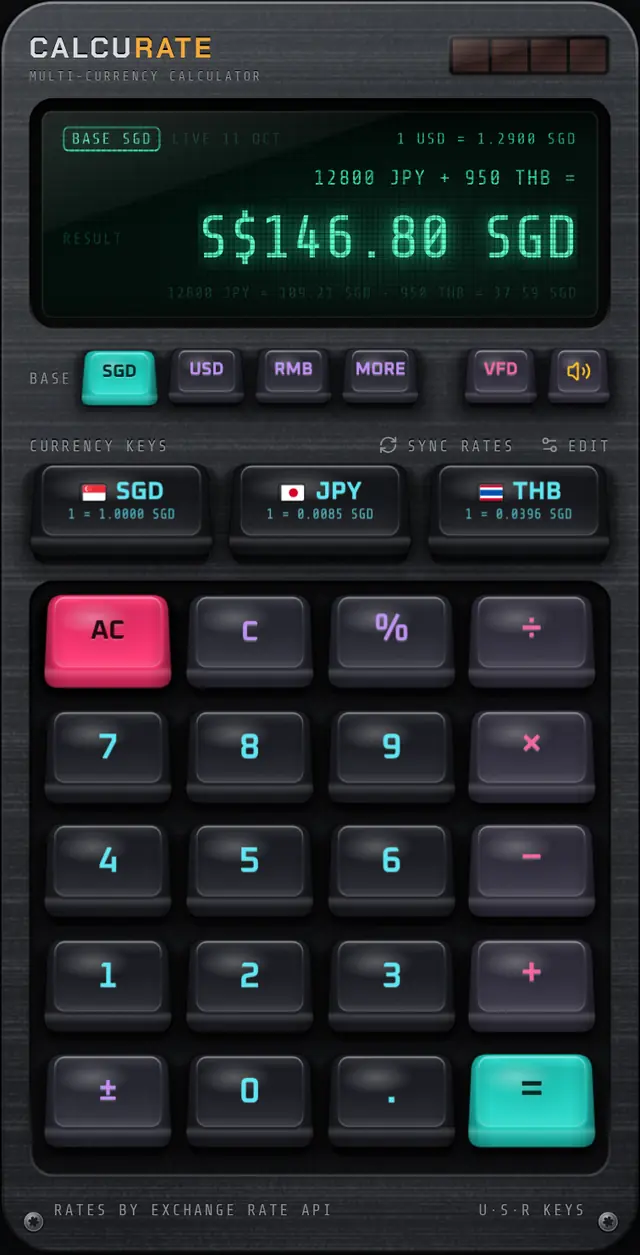
Calcurate offers three display styles you can switch with the display key. VFD gives a glowing emerald vacuum-fluorescent look, AMB gives amber phosphor, and LCD gives classic grey-green liquid crystal. All three sit behind glass with a fine mesh, a nod to the grid you would see on a real VFD, and the VFD and AMB styles add a soft glow. The display themes page shows each one.
The display is only part of that retro calculator feel. The keys matter just as much, and our guides to keycap profiles and why mechanical keyboards sound good cover the other half. For what the calculator itself can do, from mixing currencies in one sum to live exchange rates, see the features overview.
How can you spot a real VFD?
Look for a few telltale signs on old equipment.
- Self-lit segments. The digits glow on their own in a dark room, without a separate backlight behind them.
- A visible mesh over the digits, which is the control grid.
- Fine horizontal wires in front of the segments, which are the filaments.
- A glass envelope with a small sealed tip, left over from when the air was pumped out.
If the display is dark grey on a light background and disappears when you turn off the room lights, it is an LCD. If it glows like a tiny neon sign and you can see the mesh and fine wires, it is very likely a VFD.
FAQ
Questions people also ask
How does a vacuum fluorescent display work?
A heated filament inside a vacuum tube gives off electrons. A wire grid controls their flow, and when they reach a positively charged segment coated in phosphor, that segment glows.
Why are VFDs green?
The most common VFD phosphor glows a blue-green colour. Manufacturers used coloured filters over the glass, or different phosphors, to produce other colours.
Are VFDs still used today?
Yes, though less often. You can still find them in some appliances, audio equipment and point-of-sale displays, where brightness and wide viewing angles matter more than power use.
What is the difference between a VFD and an LCD?
A VFD emits its own light, while an LCD controls light that comes from a backlight or the room. VFDs are brighter and readable from wide angles; LCDs use much less power.