Why Do Mechanical Keyboards Sound Good? The Science of Thock
Why do mechanical keyboards sound good? Switch type, keycap plastic, the case and the down and up strokes all shape the sound. Here is how each part works.
Mechanical keyboards sound good because every key press makes two distinct, consistent sounds: one when the key bottoms out and one when it springs back. The switch type, keycap plastic, plate and case shape those sounds into a deeper "thock" or a sharper "clack". That clear, repeatable feedback also tells your brain each press has registered.
- Each key press has a down stroke (bottoming out) and an up stroke (returning to the top), and both make sound.
- Linear, tactile and clicky switches feel and sound different; clicky switches add a deliberate click.
- "Thock" describes a deeper, muted sound and "clack" a higher, sharper one.
- Keycap plastic, keycap shape, plate, case and stabilisers all change the sound.
- Consistent audio feedback helps you trust that a key registered, which matters when entering numbers.
People who have never thought about keyboards often stop and listen when they hear a good mechanical one. There is something satisfying about it, a crisp, even rhythm that a laptop keyboard does not make. That sound is not an accident. It comes from a handful of physical parts working together, and once you know what they are, you can hear each one.
Why do mechanical keyboards sound good?
Because each press produces clear, consistent sounds that line up exactly with what your finger feels. A mechanical keyboard has an individual switch under every key, with a spring and a moving stem. When you press, the stem travels down and usually hits the bottom of its housing. When you let go, the spring pushes it back up until it stops against the top. Both moments make a short, distinct sound.
Your brain likes that. The sound confirms the action, arrives at the same moment every time, and has a pleasant texture shaped by plastic and metal. A membrane keyboard, by contrast, squashes a rubber dome, which gives a softer, mushier sound and feel.
What are the main types of mechanical switches?
There are three broad families, defined by how they feel on the way down.
| Type | How it feels | How it sounds |
|---|---|---|
| Linear | Smooth from top to bottom, no bump | Mostly the bottom-out and return sounds |
| Tactile | A small bump partway down | Similar to linear, sometimes with a faint bump noise |
| Clicky | A bump plus a sharp click | A distinct click on top of the other sounds |
Clicky switches make the most noise on purpose. A small part inside snaps as you pass the actuation point, giving you an audible signal. Linear switches are the quietest of the three in principle, though how loud they are in practice depends on how hard you type and how the keyboard is built.
Tip: On most mechanical switches the key registers before it hits the bottom. Typing lighter, without slamming every key, is quieter and can be easier on your fingers.
What are the down stroke and up stroke?
They are the two sounds in every key press. Enthusiasts call them bottom-out and top-out.
- Down stroke (bottom-out). The stem hits the bottom of the switch housing, and the keycap may also meet the switch top. This is usually the louder, more solid part of the sound.
- Up stroke (top-out). The spring pushes the stem back until it stops against the top of the housing. This is often lighter and higher.
Listen closely to someone typing and you will hear the pairs, a heavier note followed by a lighter one. That two-part rhythm is a big part of why a mechanical keyboard sounds alive rather than flat. A recording that only plays one sound per key can sound flatter for this reason.
What is the difference between thock and clack?
Thock is deep and rounded; clack is bright and sharp. The words are informal, but most keyboard fans agree on roughly what they mean.
- Thock is lower in pitch, with less ringing. It tends to come from thicker keycaps, dense materials and a case that damps vibration.
- Clack is higher in pitch and snappier. It tends to come from thinner keycaps, harder surfaces and a more open or hollow build.
Neither is better. Some people find a muted thock calming; others like the crisp feedback of a clack. Many keyboard builds aim somewhere in between.
What else changes how a keyboard sounds?
Almost every part touching the switch. These are the main ones.
Keycaps
Keycap thickness, shape and plastic all affect the pitch. PBT is often described as sounding deeper and ABS a little higher. Taller keycaps have more air inside, which can change the tone too. Our guide to keycap profiles covers shapes and plastics in detail.
Plate and case
The plate holds the switches, and the case holds everything. Stiff metal plates tend to sound sharper. Softer or more flexible mounts and foam inside the case reduce hollow echo and push the sound towards thock.
Stabilisers
Long keys such as the space bar use stabilisers, small wire mechanisms that keep the key level. Badly tuned stabilisers rattle. Well-tuned ones make big keys sound solid and a little deeper than the rest.
Lubrication and springs
A thin layer of lubricant on switch parts reduces scratchiness and ping, a metallic ring from the spring. Heavier springs can change how hard people bottom out, which changes the sound as well.
Why does mechanical sound suit a calculator?
Because entering numbers is all about confidence that every key landed. When you add up a list of prices, a missed digit or a double press gives a wrong answer that looks perfectly reasonable. Clear feedback on each press helps you catch mistakes as they happen.
Old desk calculators understood this. Their keys had real travel and a definite feel, and you could enter figures without watching your fingers. A flat glass screen gives you none of that by default, which is why sound and haptics do so much work on a phone.
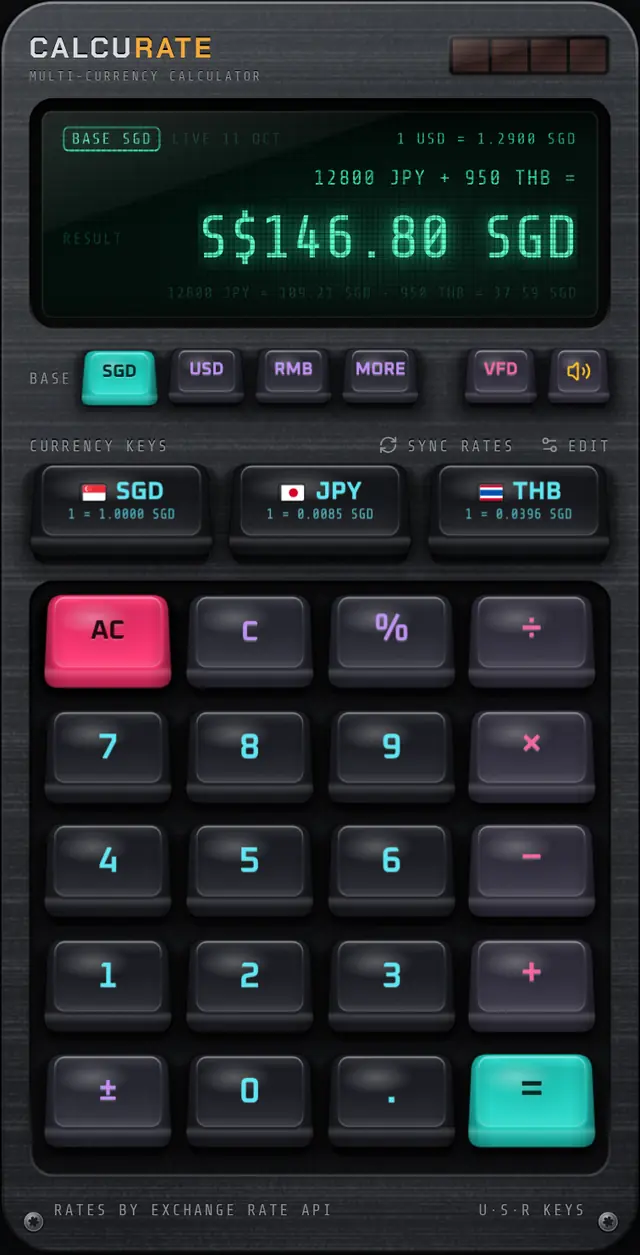
Calcurate builds its keypad around this idea. The sounds are real mechanical switch recordings, with separate down and up strokes and a deeper sound for the big = key, much like a stabilised long key on a real board. The action fires on the way down, as it would on a real switch, and the key springs back on release. Phones add a haptic tap on every press, and a mute key turns the sound off when you need quiet. You can read more on the mechanical keypad page.
How can you find the sound you like?
Listen before you buy, and change one thing at a time. A few practical steps:
- Try switch types first. Decide whether you want linear, tactile or clicky. This has the biggest effect on feel.
- Then try keycaps. Swapping keycaps is often easier than swapping switches and can move the sound noticeably.
- Add damping if it sounds hollow. Foam or a desk mat can tame echo.
- Tune the stabilisers. A rattly space bar spoils an otherwise good board.
If you want to experiment with looks rather than sound, keycap sets are the easy entry point. Calcurate lets you pop the caps off its keypad and swap between six sets in Keycap Studio. And if the retro display on old calculators fascinates you as much as their keys, read our history of the vacuum fluorescent display. For the whole picture of what the app does, see the features overview.
FAQ
Questions people also ask
What is the difference between thock and clack?
Thock is a deep, rounded, lower-pitched sound, often from thicker keycaps and a damped case. Clack is a brighter, higher-pitched sound, often from thinner keycaps or a more hollow, resonant build.
Which mechanical switches are the loudest?
Clicky switches are usually the loudest because they add a click mechanism on top of the normal bottom-out and return sounds. Linear and tactile switches have no click, though they still make noise when bottoming out.
Does a key register when it bottoms out?
Usually not. On most mechanical switches the key registers partway down, before the stem hits the bottom of the housing. Many people still press all the way down, which is where much of the sound comes from.
Do keycaps change how a keyboard sounds?
Yes. Thicker keycaps and different plastics change the pitch. PBT keycaps are often described as sounding deeper, while ABS keycaps tend to sound a little higher and sharper.