Korean Won Conversion: How to Handle Big KRW Numbers Fast
Korean won conversion is easier once you count in man (10,000). Learn the grouping, quick mental shortcuts and worked examples for prices, hotels and shopping.
Korean won figures look huge because one won is worth a small fraction of a dollar, euro or pound. Korean groups big numbers in units of 10,000 (man), so think of 50,000 won as 5 man. For quick Korean won conversion, drop three zeros and then adjust by a simple fraction that matches the current rate.
- Korean counts large numbers in groups of four digits: 1 man is 10,000 and 1 eok is 100,000,000.
- Banknotes come in 1,000, 5,000, 10,000 and 50,000 won, so many prices are round thousands.
- A quick shortcut is to drop three zeros, then scale by a fraction based on the rate you are using.
- Miscounting zeros is the most common mistake; 10 man is 100,000 won, not 10,000.
- For totals with several prices, a calculator that tags each amount with its currency avoids zero errors.
The first time you see a 45,000 won dinner bill or a 1,200,000 won hotel quote, it is hard to tell whether it is cheap or expensive. Korean won conversion is not difficult maths, but the zeros pile up fast and a single miscount changes the answer tenfold. This guide explains how Koreans group big numbers, gives you mental shortcuts that work at any rate, and walks through worked examples for the purchases you are most likely to make.
Why do Korean won prices have so many zeros?
Because one won is worth a small fraction of most major currencies, everyday prices run into thousands. A coffee might cost several thousand won and a taxi ride across a city tens of thousands. The won is not split into smaller units in daily life, so you will not see decimals on price tags.
Banknotes come in 1,000, 5,000, 10,000 and 50,000 won, with coins for smaller amounts up to 500 won. Many prices are round thousands or hundreds, which helps once you know how to read them.
How does Korean group large numbers?
Korean groups big numbers in blocks of four digits, not three. English speakers think in thousands, millions and billions. Korean thinks in units of 10,000.
| Korean | Romanised | Value |
|---|---|---|
| 천 | cheon | 1,000 |
| 만 | man | 10,000 |
| 십만 | sim-man | 100,000 (10 man) |
| 백만 | baeng-man | 1,000,000 (100 man) |
| 천만 | cheon-man | 10,000,000 (1,000 man) |
| 억 | eok | 100,000,000 (10,000 man) |
So 50,000 won is said as 5 man, and 1,200,000 won is 120 man. You will see this on signs and menus: 3만원 means 30,000 won, and some places write 1.5만 for 15,000. Spoken prices often combine units, so man o-cheon won is 15,000 won (one man plus five thousand).
Tip: To convert a figure to man, move the decimal point four places left. 250,000 won becomes 25 man; 38,000 won becomes 3.8 man.
What is the fastest mental shortcut for Korean won conversion?
Drop three zeros, then scale by what 1,000 won is worth in your currency. The scaling factor depends on the current rate, so work it out once at the start of your trip and reuse it.
Here are shortcuts for three example rates. These rates are illustrative only; check the live rate before you travel and adjust the fraction to match.
- US dollars, at an example rate of 1 USD = 1,350 KRW. 1,000 won is about 0.74 USD. Drop three zeros and take three quarters. 40,000 won becomes 40, three quarters of which is 30, so roughly 30 USD (the exact figure is 29.63 USD).
- Euros, at an example rate of 1 EUR = 1,500 KRW. 1,000 won is about 0.67 EUR. Drop three zeros and take two thirds. 60,000 won becomes 60, so about 40 EUR.
- Singapore dollars, at an example rate of 1 SGD = 1,050 KRW. 1,000 won is just under 1 SGD. Drop three zeros and knock off about 5 percent. 20,000 won is a little under 20 SGD (19.05 SGD exactly).
The general method is covered in our guide to mental maths for currency conversion.
How much is 10,000 won? A quick reference table
Learn what 1 man is worth in your currency and you can scale everything else from it. At an example rate of 1 USD = 1,350 KRW:
| Won | In man | USD (example rate) |
|---|---|---|
| 10,000 | 1 man | 7.41 |
| 30,000 | 3 man | 22.22 |
| 50,000 | 5 man | 37.04 |
| 100,000 | 10 man | 74.07 |
| 500,000 | 50 man | 370.37 |
| 1,000,000 | 100 man | 740.74 |
Notice the pattern: each step of ten in man adds a zero to the dollar figure. If 1 man is about 7.4 USD, then 10 man is about 74 USD and 100 man is about 740 USD.
Worked examples for a trip to Korea
All of these use the same illustrative rate of 1 USD = 1,350 KRW, with US dollars as the currency the answer is shown in.
A hotel booked by the night
Three nights at 120,000 won a night. In man, that is 12 man times 3, or 36 man. Mentally, 36 man at about 7.4 USD each is roughly 266 USD.
A shopping day with a pre-paid booking
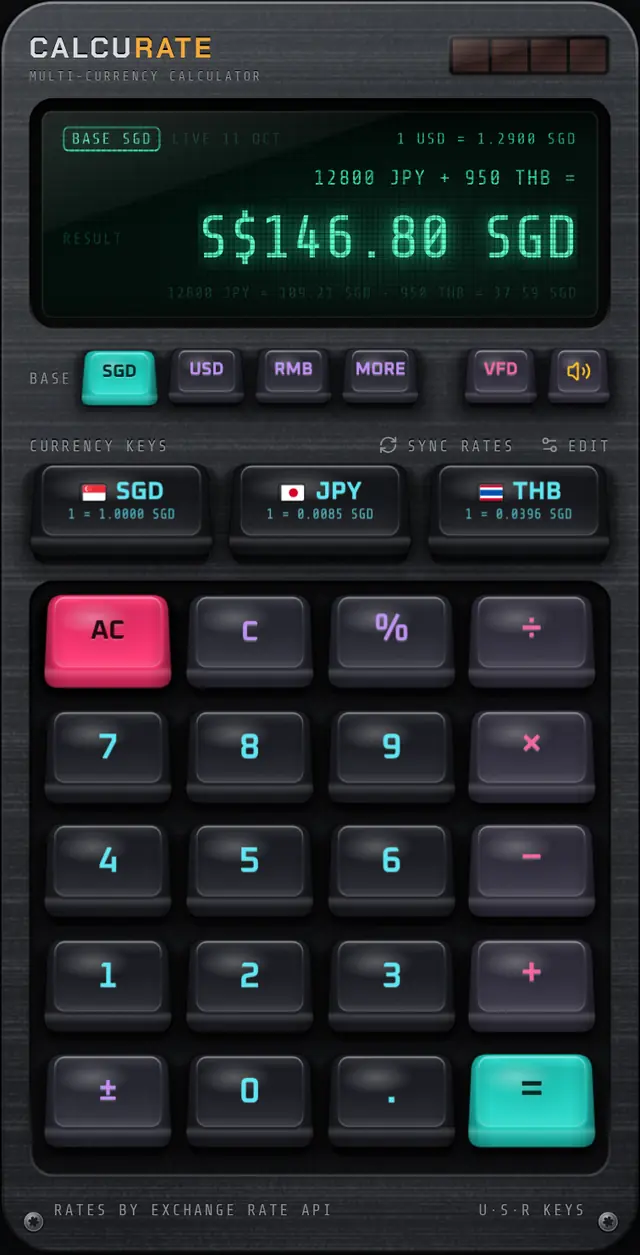
You buy a jacket for 89,000 won and skincare for 45,000 won, and you already paid 25 USD online for a palace tour. To see the day's total in one figure:
The two won amounts come to 134,000 won, about 99.26 USD at the example rate, plus the 25 USD tour.
Splitting a group dinner
A barbecue dinner for four costs 172,000 won. Each person's share is 43,000 won, which is 4.3 man, or about 31.85 USD at the example rate.
For more on dividing costs fairly, see how to split bills in multiple currencies.
How do you avoid zero errors with won?
Say the number in man before you convert it. Most mistakes come from reading 100,000 as 10,000 or 1,500,000 as 150,000. Converting to man first gives you a small, easy number (10, or 150) that you are less likely to mangle.
Other habits that help:
- Group the digits. When typing a big figure, count digits from the right in fours: 1,500,000 is 150 / 0000, so 150 man.
- Sanity-check against a known price. If a coffee costs about 5,000 won, a 50,000 won meal is ten coffees. Does that feel right?
- Tag amounts with their currency. In a currency calculator that supports it, you type
120000and tap a KRW key, and the app converts it for you. Calcurate works this way, and its breakdown line shows each conversion so you can spot a missing zero straight away. KRW is one of its 15 supported currencies and can sit on one of the three quick currency keys. - Decline conversion at the terminal. If a card machine offers to charge you in your home currency, you are usually better off paying in won. Our guide to dynamic currency conversion explains why.
What about really big numbers like eok?
You mostly meet eok (100,000,000 won) in property listings, rental deposits and salary discussions, not in shops. The same shortcut works: 1 eok is 10,000 man. At the example rate of 1 USD = 1,350 KRW, 1 eok is about 74,074 USD, so 3.5 eok is roughly 259,000 USD.
For figures this size, typing the amount into a calculator is safer than mental maths, because a slipped digit is expensive. Remember that any app shows reference rates; the rate a bank applies to a large transfer can differ, and for anything significant you should check with the provider. This guide is not financial advice.
Keep a rate at a glance
If you check won prices often, a home screen widget saves opening an app each time. Calcurate's widgets can show the rate both ways and, in the Medium (iOS) or wide (Android) size, three round amounts converted, which is handy for scaling won figures on the spot. Setup is on the home screen widgets page. Whatever tool you use, the habit that matters most is the same: read it in man, then convert.
FAQ
Questions people also ask
What does man mean in Korean prices?
Man (written 만) means 10,000. A price of 3만 원 is 30,000 won, and 15만 원 is 150,000 won.
Why are Korean won prices so large?
Each won is worth a small amount compared with currencies like the US dollar or euro, so everyday prices run into thousands or tens of thousands of won. The won is not usually divided into smaller units in daily use.
What is a quick way to convert Korean won in your head?
Drop the last three zeros, then multiply by how much 1,000 won is worth in your currency at the current rate. For example, at an illustrative rate of 1 USD = 1,350 KRW, 1,000 won is about 0.74 USD, so take roughly three quarters of the remaining number.
What is an eok in Korean money?
Eok (억) means 100,000,000, or 10,000 man. You mostly see it in property prices, deposits and salaries rather than in shops.