How Are Exchange Rates Determined? A Plain-English Guide
Exchange rates are set by supply and demand in currency markets, steered by central banks and pegs. See what moves rates and how reference rates work.
Most exchange rates are determined by supply and demand in the global currency market, where banks, businesses and investors buy and sell currencies all day. Interest rates, inflation, trade and investor confidence shift that demand, while some central banks peg or manage their currency. Reference rates, such as the European Central Bank's euro rates, are daily snapshots of those market prices.
- Floating currencies are priced by supply and demand in the foreign exchange market.
- Interest rates, inflation, trade flows, capital flows and risk sentiment are the main forces that move rates.
- Some currencies are pegged or managed: the Hong Kong dollar is linked to the US dollar, and China and Singapore manage their currencies in different ways.
- Reference rates such as the ECB euro rates are snapshots published at a set time, used as benchmarks.
- The rate a consumer gets is the market rate plus a spread and any fees.
An exchange rate is simply the price of one currency in terms of another. Like most prices, it is shaped by how many people want to buy and how many want to sell. What makes currencies interesting is who those buyers and sellers are, what changes their minds, and how governments sometimes step in. This guide walks through each part, then explains where the daily reference rates you see in apps actually come from.
How are exchange rates determined?
Most exchange rates are determined by supply and demand in the foreign exchange market. When more people want to buy a currency than sell it, its price rises. When more want to sell, it falls. The market has no single building or exchange; it is a network of banks, brokers and electronic trading platforms that operates around the clock on weekdays.
Demand for a currency comes from many places:
- Trade. A company importing goods from Japan needs yen to pay its supplier.
- Investment. A fund buying shares or bonds in another country needs that country's currency.
- Travel and remittances. Tourists and people sending money home convert currencies too, though in smaller amounts.
- Speculation and hedging. Traders take positions on where rates will go, and businesses lock in rates to protect themselves.
Each of these flows pushes the price a little. The price you see at any moment is where buyers and sellers currently meet.
What makes a currency go up or down?
A currency usually rises when people expect better returns or more stability from holding it, and falls when they expect the opposite. Several forces feed into that.
Interest rates
Higher interest rates tend to attract investors looking for a better return on deposits and bonds, which increases demand for the currency. That is why markets react strongly to central bank rate decisions, and even to hints about future decisions.
Inflation
If prices rise faster in one country than another, each unit of its currency buys less over time. Over the long run, currencies with persistently high inflation tend to weaken.
Trade and the current account
A country that exports more than it imports receives a steady flow of foreign money that has to be converted into its own currency, which supports demand. A country that imports more needs to sell its currency to pay for those goods.
Growth, politics and risk sentiment
Strong economic data, stable politics and predictable policy make a currency more attractive. In times of global stress, investors often move into currencies they see as safe, and out of those they see as risky.
Expectations
Markets trade on what they think will happen, not only on what has happened. A rate decision that everyone expected may barely move a currency, while a surprise can move it sharply.
Do governments set exchange rates?
Some do, some steer, and some leave it to the market. Countries choose different exchange rate regimes, and the regime decides how much the market alone sets the price.
| Regime | How it works | Examples |
|---|---|---|
| Free float | The market sets the rate; the central bank rarely intervenes directly. | US dollar, euro, British pound, Japanese yen, Australian dollar |
| Peg or currency board | The rate is held at or within a narrow band around a fixed level against another currency. | Hong Kong dollar, linked to the US dollar |
| Managed float | The market moves the rate, but the authorities guide it within limits or against a basket. | Chinese yuan, Singapore dollar |
The Hong Kong dollar has been linked to the US dollar since 1983, and the Hong Kong Monetary Authority keeps it within a narrow band. China's central bank publishes a daily central parity rate for the yuan against the US dollar, and onshore trading is allowed only within a band around it. Singapore takes another route: its central bank manages the Singapore dollar against an undisclosed basket of currencies, using the exchange rate rather than interest rates as its main policy tool. If the yuan's onshore and offshore rates confuse you, see our explainer on RMB vs CNY.
Even free-floating currencies are not untouched. Central banks shape them through interest rates and, occasionally, by buying or selling currency in the market.
What are reference rates, such as the ECB's?
A reference rate is a published snapshot of market exchange rates taken at a fixed time. It gives everyone the same number to point to, which is useful for accounting, contracts, statistics and everyday conversions.
The best-known example is the set of euro reference rates published by the European Central Bank. On working days, the ECB publishes the value of one euro in a list of other currencies, based on market rates around a set time in the afternoon (Central European Time). The ECB states that these rates are for information purposes only. You cannot trade at them; they are a record of where the market was.
Other benchmarks exist too. Financial data providers publish daily fixing rates used by fund managers, and many central banks publish their own reference rates for their currency.
Tip: Reference rates are published only on working days. Over a weekend or public holiday, a service using them shows the most recent working day's rate, so the date matters as much as the number.
How does the market rate become the rate you pay?
The market price is the starting point, then a provider adds its margin. The midpoint between wholesale buy and sell prices is called the mid-market rate. Banks, card networks and exchange counters quote you a rate a little worse than that, and may charge a separate fee as well.
Here is how that looks with illustrative numbers:
The 20 USD difference is the spread. Card policies and fees vary widely, so the gap you face depends on your provider. One case to watch is dynamic currency conversion, where a merchant offers to charge you in your home currency at a rate it chooses.
Where do currency apps get their rates?
Many apps pull rates from a data provider and refresh them on a schedule. The rate shown is usually a mid-market or reference rate, not the rate your bank will apply.
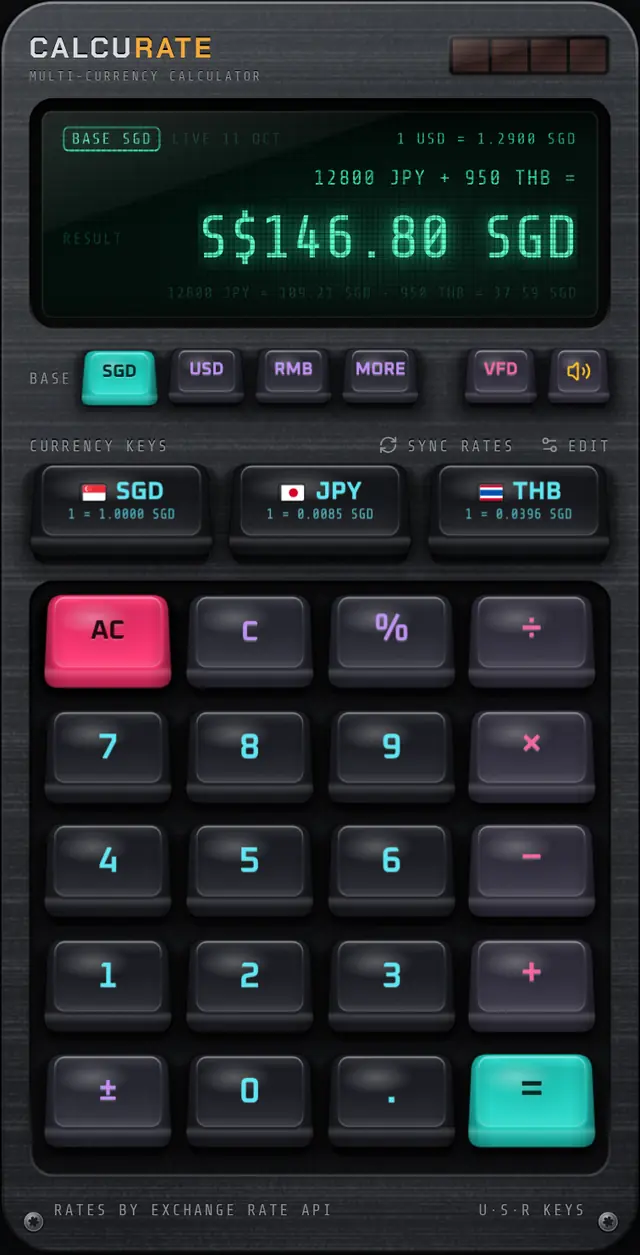
Calcurate, for example, uses live rates from ExchangeRate-API, updated once a day, and falls back to ECB reference rates via Frankfurter (updated each working day) if that source is unavailable. The display shows which source was used and the date the rates were published, such as LIVE 10 OCT or ECB 09 OCT. If your phone is offline, it reuses rates cached on the device for up to an hour; after that it falls back to rates bundled with the app, which go out of date, and the display says OFFLINE. The live exchange rates page covers this in more detail, and the FAQ answers common questions about rate freshness.
Whatever tool you use, check the date and source before relying on a figure, especially if a currency has been moving fast. In Calcurate, SYNC RATES fetches fresh rates on demand if you want the latest available figure before a big purchase.
Why do rates differ between websites?
Rates differ because sources sample the market at different times and from different providers. A site updating every minute will rarely match one using a daily reference rate. Small gaps are normal. If two sources differ a lot, one of them is probably out of date or is showing a retail rate with a margin included.
The short version
Exchange rates come from supply and demand in a global market. Interest rates, inflation, trade, investment and confidence move that demand. Some governments peg or manage their currencies, which limits how far the market can move them. Reference rates like the ECB's are daily snapshots used as benchmarks, and the rate you actually pay is that market rate plus a provider's margin. Knowing those layers makes it much easier to judge any quote. To see how this plays out when you add up amounts in several currencies, read how to add prices in different currencies.
FAQ
Questions people also ask
Who sets exchange rates?
For most major currencies, nobody sets them directly. Prices emerge from trading between banks, businesses and investors, although central banks influence them through interest rates and, for pegged or managed currencies, through direct intervention.
What is an ECB reference rate?
It is a euro exchange rate published by the European Central Bank on working days for a list of currencies. It is a snapshot taken at a set time each day and is meant for information and benchmarking, not as a rate you can trade at.
Why do exchange rates change every day?
Because the balance of buyers and sellers changes constantly. News about interest rates, inflation, economic data or politics changes what people expect, and prices adjust within seconds.
What is the difference between a floating and a pegged currency?
A floating currency moves freely with market demand. A pegged currency is held at or near a fixed rate against another currency by its central bank or monetary authority.