RMB vs CNY: What Is the Difference? (Plus CNH Explained)
RMB and CNY refer to the same Chinese currency: renminbi is its name, CNY its ISO code. Learn what yuan and CNH mean and why offshore rates differ.
RMB and CNY are the same currency. Renminbi (RMB) is the official name of China's currency, the yuan is its main unit, and CNY is its international ISO 4217 code. CNH is a market label for the same yuan traded offshore, mainly in Hong Kong, and its rate can differ slightly from the onshore CNY rate.
- Renminbi (RMB) is the name of the currency; yuan is the unit you count in; CNY is the ISO code.
- Prices in China are quoted in yuan, often written with the character 元 or the symbol ¥.
- CNH is the offshore yuan, traded mainly in Hong Kong. It is not an ISO code, but it is widely used in financial markets.
- CNY and CNH are the same currency, but their exchange rates can differ slightly because the markets are separate.
- For travel and shopping maths, the small CNY and CNH gap rarely matters; your card or exchange provider's margin usually matters more.
If you have ever paid a supplier in China, booked a hotel in Shanghai or compared prices on a Chinese shopping site, you have probably seen RMB, CNY, yuan and sometimes CNH, all apparently meaning the same thing. They mostly do, but each label has a specific job. Once you know which is which, invoices, bank statements and currency apps make a lot more sense.
Is there a difference between RMB and CNY?
No, RMB and CNY are the same currency. RMB stands for renminbi, which is the official name of the currency of the People's Republic of China. CNY is the three-letter code assigned to it under the ISO 4217 standard, which banks, payment networks and airlines use to identify currencies.
So "300 RMB" and "300 CNY" are the same amount of money. The difference is only in context: RMB is common in everyday writing and conversation, while CNY appears on bank transfers, card statements and foreign exchange quotes.
| Label | What it is | Where you see it |
|---|---|---|
| Renminbi (RMB) | The name of the currency | News, invoices, everyday writing |
| Yuan | The unit of the currency | Price tags, conversation, menus |
| CNY | The ISO 4217 code | Banks, cards, airline fares, FX quotes |
| CNH | Market label for offshore yuan | Trading platforms, offshore banking |
What is the difference between renminbi and yuan?
Renminbi is the currency; yuan is the unit you count it in. The name renminbi means "people's currency". When you buy a coffee, the price is a number of yuan, not a number of renminbi, in the same way that the British currency is sterling but prices are in pounds.
The yuan is split into smaller units:
- 1 yuan = 10 jiao
- 1 jiao = 10 fen, so 1 yuan = 100 fen
In spoken Mandarin you will often hear kuai instead of yuan, and mao instead of jiao. These are informal words for the same units. On price tags you will usually see the character 元 or the symbol ¥.
Tip: The ¥ symbol is shared with the Japanese yen. If you are comparing prices from China and Japan, check the currency code (CNY or JPY) rather than the symbol. The two are worth very different amounts, so a mix-up can be expensive.
What is CNH, the offshore yuan?
CNH is the label used for yuan that trade outside mainland China, with Hong Kong as the main centre. It is the same currency as CNY. A yuan is a yuan wherever it sits. The difference is the market it trades in and the rules that apply there.
China keeps controls on how money moves in and out of the mainland. Onshore, the yuan (CNY) trades within a band around a daily central parity rate set by the People's Bank of China. Offshore, the yuan (CNH) trades more freely and responds to global supply and demand without that band. Because the two markets are linked but not fully connected, their prices can drift apart.
A few points worth knowing about CNH:
- It is not an official ISO code. CNY is the only ISO code for the currency. CNH is a convention adopted by banks and trading platforms.
- The gap is usually small. The CNY and CNH rates normally sit close together, though the difference can widen during periods of market stress.
- Businesses meet it more than travellers. If you hold yuan in an account outside the mainland or trade currencies, you may be dealing in CNH. Tourists rarely need to think about it.
For background on why some currencies trade freely and others are managed, see how exchange rates are determined.
Does the CNY vs CNH gap matter for travel and shopping?
For most people, no. When you pay with a card or change cash, the provider's spread and fees almost always matter more than the small difference between onshore and offshore rates. The bigger question is how far your rate is from the mid-market rate.
Here is a simple example using an illustrative rate of 1 RMB = 0.1860 SGD:
If the CNH rate were, say, 0.1855 SGD instead (again an example), the same 300 yuan would be about 55.65 SGD. A gap of 15 cents is small next to a card that adds a few percent on top of the market rate. A converter such as Calcurate shows mid-market reference rates, which makes it a good benchmark for spotting that kind of markup.
Which should you use on an invoice: RMB or CNY?
Use CNY when precision matters, such as invoices, contracts and bank payment instructions. It is the ISO code, so there is no doubt about which currency you mean. Writing "RMB" is widely understood and perfectly fine in emails and quotes, but payment systems are built around ISO codes.
- Invoices and contracts: state the amount in CNY, and say whether the payment is to be made onshore or offshore if that is relevant to your bank.
- Price lists for customers: RMB or ¥ with a clear note that prices are in Chinese yuan.
- Accounting: record which rate you used and its date, because onshore, offshore and reference rates can all differ slightly.
If you invoice clients in several currencies, our guide to multi-currency invoices for freelancers covers the practical side.
How do you add up amounts in RMB and other currencies?
Convert each amount into one currency, then add. Doing that by hand for a list of mixed prices is slow, which is where a multi-currency calculator helps.
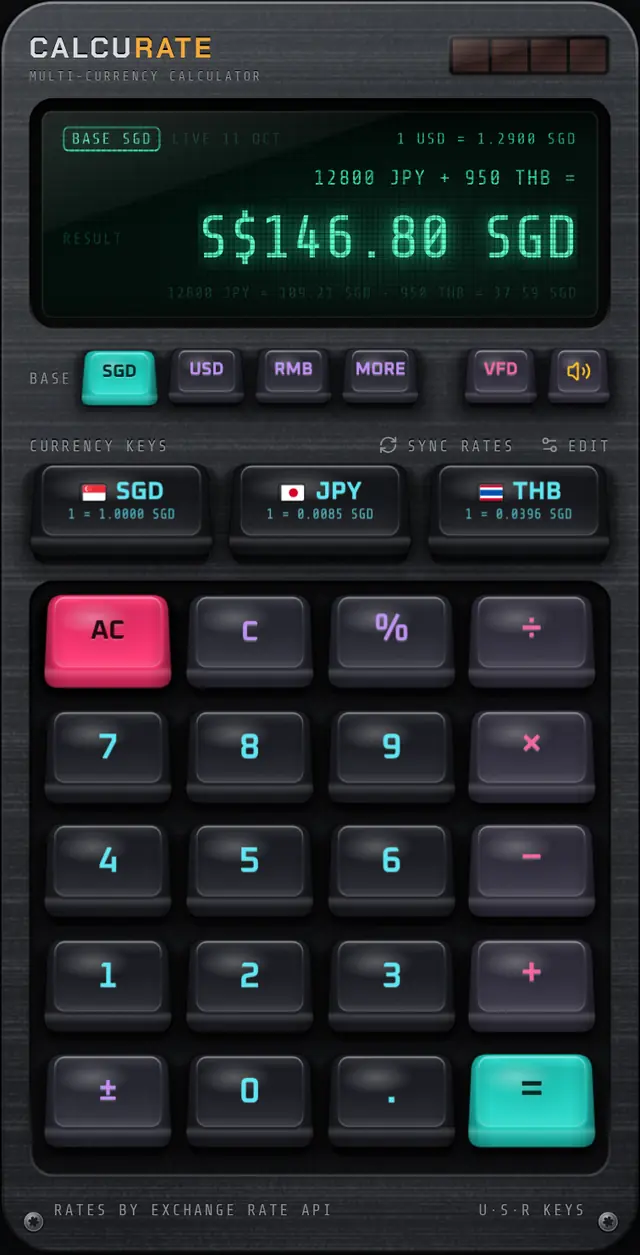
In Calcurate, the currency key is labelled RMB (ISO code CNY), one of the 15 listed on the currencies page. RMB is one of the three default quick currency keys, alongside USD and SGD, and it can also be the base currency your answers are shown in. You can type a sum like 120 USD + 85 SGD + 300 RMB, press =, and get the total in your base currency, with a breakdown line such as 300 RMB ≈ 55.80 SGD (at the example rate above) showing each conversion. Rates are mid-market reference rates, so treat the result as a benchmark rather than what your bank will charge. The multi-currency maths page explains how tagging amounts works.
Summary
RMB and CNY mean the same currency: renminbi is the name and CNY is the ISO code. The yuan is the unit you count in, split into 10 jiao or 100 fen. CNH is the same yuan traded offshore, mainly in Hong Kong, and its rate can differ a little from onshore CNY because the markets are separate. For everyday spending, focus on the rate and fees your provider charges, and use CNY on anything official. For more on handling mixed-currency totals, read how to add prices in different currencies.
FAQ
Questions people also ask
Is RMB the same as CNY?
Yes. RMB is the abbreviation for renminbi, the name of the currency, and CNY is its ISO 4217 code used by banks and payment systems. They refer to the same money.
What is the difference between yuan and renminbi?
Renminbi is the name of the currency as a whole, while the yuan is its unit of account. It is similar to how sterling is the currency and the pound is its unit.
What is CNH?
CNH is the label used for yuan traded outside mainland China, mainly in Hong Kong. It is the same currency as CNY, but it trades in a separate market, so its exchange rate can be slightly different.
Why is the yuan symbol the same as the Japanese yen symbol?
Both currencies use the ¥ symbol because "yuan" and "yen" come from the same historical word. To avoid confusion, people often write CN¥ or RMB for the yuan, and JP¥ or JPY for the yen.