How to Invoice Clients in Different Currencies as a Freelancer
How to invoice clients in different currencies: choose the invoice currency, price with a buffer, track what you actually receive and total your income at home.
To invoice clients in different currencies, agree the currency up front, put the ISO currency code on every amount, and state who pays transfer fees. Set your price in your home currency first, convert it with a small buffer for rate moves, and record what actually lands in your account, converted at a rate your accountant or tax authority accepts.
- Whichever side deals in a currency that is not its own carries the exchange-rate risk between invoice date and payment date.
- Write currency codes (USD, EUR, GBP) on invoices instead of symbols like "$", which can mean several currencies.
- Price in your home currency first, then convert with a small buffer to absorb rate movement.
- Track the amount actually received, not just the amount invoiced, because transfer and conversion costs reduce it.
- Tax rules on which exchange rate to use differ by country; check with an accountant or your tax authority.
Once you have clients in more than one country, invoicing gets an extra layer. You have to decide which currency to bill in, how to price so a rate swing does not eat your margin, and how to total income that arrives in three currencies. This guide walks through each step with worked examples. All exchange rates below are illustrative examples, and nothing here is tax or financial advice.
Which currency should you invoice in?
Agree it with the client before you start the work, and pick based on who should carry the exchange-rate risk. Between the day you send an invoice and the day it is paid, rates move. Whichever side is dealing in a currency other than its own is exposed to that movement.
| Invoice in | Good for you | Watch out for |
|---|---|---|
| Your home currency | You know exactly what you will receive before fees | Clients may find it harder to pay and compare quotes |
| Client's currency | Easy for the client to approve and pay | Your income in home currency changes with the rate |
| A third currency (often USD or EUR) | Familiar to both sides on international work | You may face two conversions and two sets of costs |
There is no single right answer. Many freelancers invoice large or long-term clients in the client's currency to make life easy for them, then build a small buffer into the price.
How do you price work in a foreign currency?
Start from what you need in your home currency, convert it, then add a buffer. Say you want 6,000 SGD for a project and the client pays in US dollars. At an example rate of 1 USD = 1.30 SGD:
You might round that to 4,750 USD on the quote. The 3% is an example; choose a buffer that reflects how volatile the pair is, how long your payment terms are and how much you expect to lose to transfer costs.
Use the mid-market rate as your starting point, since it sits between the buy and sell rates banks quote. The rate you actually get when converting will usually be a little worse.
What should a multi-currency invoice include?
Everything a client's accounts team needs to pay the right amount in the right currency, first time:
- Currency code on every amount. Write 4,750.00 USD, not $4,750. The "$" sign is used by many currencies.
- Who pays transfer fees. A line such as "all transfer fees to be paid by the sender" avoids short payments.
- Bank details for that currency. If you have an account that receives the client's currency directly, give those details on that client's invoices.
- Payment terms and due date. Shorter terms mean less time for the rate to move.
- Any tax lines your local rules require. Cross-border invoices can have specific tax wording. Check with an accountant.
Tip: Keep one invoice template per currency, with the bank details and currency code already filled in. It is much harder to send a EUR invoice with USD bank details by mistake.
How do you know what you actually earned?
Record what lands in your account, not just what you invoiced. Intermediary banks, payment platforms and currency conversion can all take a slice, and the amounts vary by route and provider.
Suppose you invoiced 2,400 USD and 2,352 USD arrived:
That is 62.40 SGD lost on one payment. Over a year of monthly invoices, it is worth knowing about, and it might be a reason to change payment method or add a fees clause.
The rate also matters. If you invoice 1,800 EUR when the example rate is 1 EUR = 1.50 SGD, that is 2,700 SGD. If the rate has moved to 1 EUR = 1.46 SGD by the time you are paid, the same 1,800 EUR is worth 2,628 SGD, a drop of 72 SGD you did nothing to cause. It can move in your favour too. This is the risk the buffer is for.
How do you total monthly income across currencies?
Convert each payment into your home currency and add them up. Say this month you were paid by three clients:
| Client | Paid | Example rate | In SGD |
|---|---|---|---|
| US agency | 2,400 USD | 1 USD = 1.30 SGD | 3,120.00 SGD |
| German startup | 1,800 EUR | 1 EUR = 1.50 SGD | 2,700.00 SGD |
| UK publisher | 950 GBP | 1 GBP = 1.75 SGD | 1,662.50 SGD |
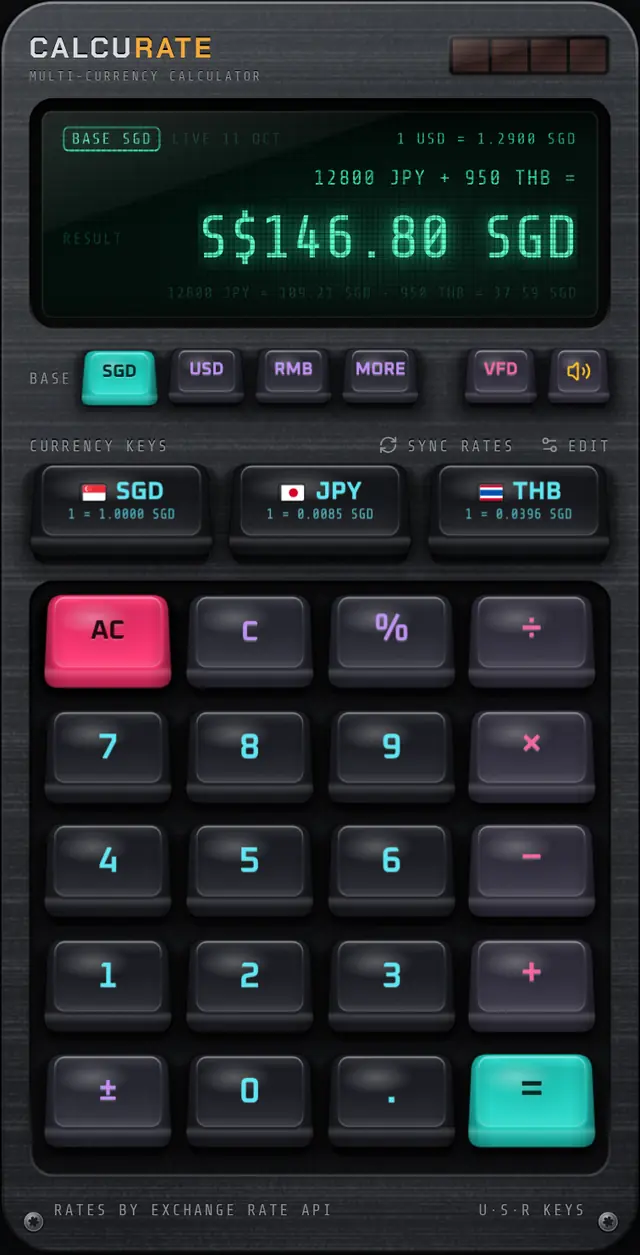
For a quick answer, a multi-currency calculator saves the three separate conversions. In Calcurate you can set USD, EUR and GBP as your three quick currency keys and SGD (or another currency on the base keys) as the base, then type the line above and press =. The display shows the total and a breakdown of each conversion, and you can switch the base currency to see the same total in another currency instantly. See multi-currency maths for how the keys work.
The Calcurate display also shows where the rates came from and the date they were published, which is handy for a quick check. Keep in mind they are mid-market reference rates from live exchange rate sources, not the rate your bank applied or an official tax rate.
Which exchange rate should you use for tax records?
The one your tax rules ask for. Countries differ. Some accept the rate on the invoice date, some the date of payment, some publish official monthly or annual rates, and some let you choose a method as long as you apply it consistently. This is a question for an accountant or your tax authority's published guidance, not a calculator.
Whatever method you use, keep the evidence: the invoice, the bank statement showing what arrived and in which currency, and a note of the rate and its source.
A simple multi-currency invoicing routine
- Agree the invoice currency and payment terms before work starts.
- Price in your home currency, convert at the mid-market rate and add a buffer.
- Use a per-currency template with ISO codes and the right bank details.
- State who pays transfer fees.
- Record the amount received and the date, next to the amount invoiced.
- Total each month in your home currency and compare with your target.
- Hand your accountant the records in the format your tax rules need.
If your expenses are also spread across currencies, our guide to managing multi-currency expenses covers the other side of the ledger, and how to add prices in different currencies explains the maths behind totals like the one above. You can see every supported currency on the currencies page.
FAQ
Questions people also ask
Should I invoice in my currency or my client's currency?
Invoicing in your own currency moves the exchange-rate risk to the client, while invoicing in theirs makes you easier to pay but leaves the risk with you. Many freelancers use the client's currency for larger or long-term clients and add a small buffer to the price.
What exchange rate should I use for my accounts?
It depends on your country's tax rules. Some allow the rate on the invoice date, some the payment date, and some publish official rates. Ask an accountant or check your tax authority's guidance, and apply the same method consistently.
Who pays the fees on an international payment?
Whoever the invoice says pays them, so state it clearly. Without that line, fees are often deducted along the way and you receive less than the invoiced amount.
How do I add up income from clients paying in different currencies?
Convert each payment into your home currency and add them. A multi-currency calculator lets you type each amount with its currency and get one total, but for your records use the rate your tax rules require.